Sources#
Summary#
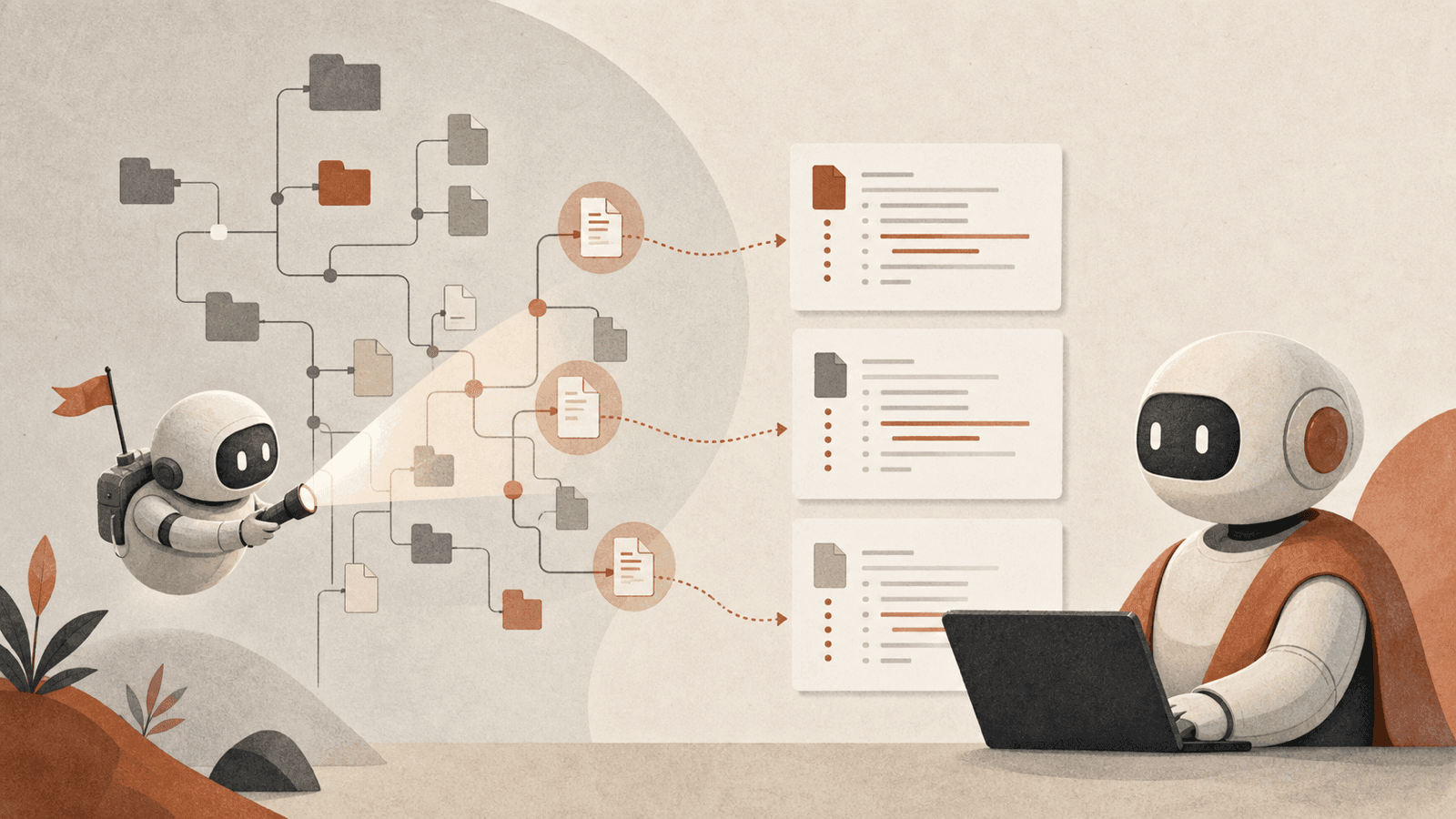
In most coding agents, one model both explores the repository (reading files, globbing paths, grepping for symbols to locate the relevant code) and solves the task (editing, running tests, producing a patch). Exploration is expensive and it pollutes: every exploratory read and search stays in the solver's conversation history, consuming token budget and burying the actual decision point under irrelevant snippets. FastContext (Shaoqiu Zhang et al., Microsoft CoreAI + Shanghai Jiao Tong University, June 2026) argues that repository exploration should instead be a first-class, separable, trainable component — a dedicated subagent invoked on demand that runs read-only parallel tool calls and returns only compact file-and-line citations as focused context. Integrated into Mini-SWE-Agent, this lifts end-to-end resolution up to 5.5% while cutting main-agent token consumption up to 60%, with marginal overhead. See the system instance at FastContext.
The bottleneck: exploration dominates the solver trajectory#
The motivating analysis runs all 300 GPT-5.4-high Mini-SWE-Agent trajectories on SWE-bench Multilingual and categorizes tool calls into reading, searching, editing, testing, and other:
- Reading + searching = 9.96 of 17.72 tool-use turns (56.2%) and 46.5% of the main agent's total tokens. That token share is direct inference cost and context the solver must carry forward.
- Exploration is a long sequential prelude before editing. Across the 284 trajectories where a first source edit is identifiable, the agent starts editing at turn 8.47 on average. Even with parallel tool calls enabled, the median trajectory still requires 6 sequential exploration turns and 15.5 exploration tool calls before the first edit.
- Harder issues explore more. Unresolved trajectories average 8.34 pre-edit exploration turns vs. 6.67 for resolved ones. The claim is not that exploration causes failure but that it is (a) costly enough to matter and (b) structured enough to delegate.
Two distinct harms follow: a token/context-cost harm (the solver pays for and carries every exploratory snippet — see Context Window Smart Zone) and a noise harm (when exploration misses key files or accumulates irrelevant context, the solver reasons from a polluted window and may spend later turns repairing a mistaken hypothesis rather than fixing the true cause).
This is the same bottleneck that motivated SWE-Pruner (Wang et al., 2026, context pruning for coding agents) — and the contrast is instructive. Pruning removes the polluted context after the fact; the exploration-subagent approach never pollutes it by keeping search in a separate conversation. Two strategies, same problem.
The delegation contract#
FastContext is a runtime delegation mechanism, not a new model architecture. The main agent hands it a natural-language query ("find the code paths for Goldmark image render hooks…") and receives back evidence, not a patch. Three deliberate design choices define the contract:
- Three language-agnostic read-only tools, and nothing else:
READ(line-numbered file contents),GLOB(path discovery),GREP(regex search, ripgrep). The explorer cannot edit files or submit patches — it is structurally incapable of solving, only of locating. - Parallel-by-turn. At each turn the explorer either issues one or more tool calls (executed concurrently, to cover complementary hypotheses before synthesizing) or stops with a final answer.
- A compact output contract. The return is a
<final_answer>block ofpath:line-rangeentries with optional short relevance notes, e.g.:
<final_answer>
/src/router.py:42-58 (Router definition)
/tests/test_router.py:101-119
</final_answer>
Only this block re-enters the main agent's context. The explorer's intermediate tool observations and reasoning are written to separate subagent logs and never appended to the solver trajectory — this is the mechanism that keeps the main context clean. In Mini-SWE-Agent it runs as a CLI helper inside the same task container (fastcontext -q "..." --format concise).
This is the open, published mirror of the proprietary "subagent" features shipping in Claude Code, Codex, GitHub Copilot CLI, and Cursor — the paper's stated motivation is that those exploration mechanisms are closed, leaving no open training/evaluation recipe.
Training recipe: SFT then task-grounded RL#
The explorers are trained, not just prompted, in two stages (backbones: Qwen3-4B-Instruct for the 4B explorer, Qwen3-Coder-30BA3B for the 30B):
- SFT (policy initialization). 2,954 filtered examples from Sonnet 4.6 (Anthropic) exploration traces, decomposed into three sub-sources that mirror the runtime behaviors:
parallel_toolcalls(990 — broad nonredundant first-turn search),multiturn_traj(983 — full multi-turn evidence-gathering trajectories), andlinerange(981 — precise final-citation generation). Assistant-token-only loss masks raw tool observations while keeping both assistant text and structured tool-call arguments in the objective. - RL (task-grounded refinement). GRPO from the SFT checkpoint over 400 prompts / 395 repositories. The key move: the reward is derived from the reference patch. Each issue's gold patch is parsed into target file/line ranges (avg 11.07 ranges/prompt), and the reward combines (a) file-level + line-level F1 of the explorer's citations against those targets, (b) a small bounded-parallelism bonus (
1if 3 < max-parallel-calls ≤ 6), and (c) a format penalty rejecting empty, overly long, malformed, or excessive-fan-out outputs. The explorer is rolled out as the real subagent (up to 8 turns, 16 sampled trajectories/prompt). SFT teaches imitation of exploration behavior; RL aligns the output with the code locations that actually matter for the fix.
Three findings worth keeping#
- The architectural separation is the durable win; the trained model is the optimization. A baseline called same-model exploration — the frontier model itself performs the delegated search through the subagent interface, with no specialized training — already improves score and cuts tokens versus monolithic solving. So a real share of the benefit comes purely from moving exploration out of the solver's context, independent of any small trained model. The trained explorer is then a Pareto improvement on top (often dominating same-model exploration in both score and tokens).
- A 4B-RL explorer can beat a 30B-SFT one. On GLM-5.1 / SWE-bench Pro, the 4B-RL explorer reaches 22.5 vs. 20.0 for 30B-SFT while using fewer tokens, and 4B-RL improves or ties 4B-SFT in all nine end-to-end settings. Task-grounded RL beats raw scale for this narrow role; the RL gains come mainly from higher recall at similar precision — exactly what a patch-coverage reward optimizes for. (Standalone localization: trained FastContext reaches 73.71 file-level F1 / 60.35 module-level F1, the strongest non-frontier group, with the clearest edge at module/function granularity.)
- The explorer is cheap. Token/cost audit on GPT-5.4 / SWE-bench Multilingual: direct solving is $282.47/task; main+4B-RL is $208.92 + $4.52 explorer = $213.44, a net saving of ~$69/task (the 4B explorer billed at a $0.20/Mtok serverless tier). Efficiency is the whole point — exploration has to be cheap enough to run as a routine helper, which is why the 4B model (not the 30B) is the deployment target.
Connections#
- FastContext — the system instance: the trained 4B–30B explorers, model variants, training stack, and open release
- Deep Modules for Agents — an exploration subagent is a deep module: a thin interface (NL query → file-line citations) hiding large behavior (multi-turn parallel search), and a concrete realization of Pocock's "reviewer in fresh context" / Sandcastle pattern applied to search rather than review — the solver delegates and keeps a clean window
- Agent Harness Engineering — decoupling exploration from solving and returning only compact evidence is harness design: progressive context disclosure and isolation enforced mechanically (the explorer cannot edit), not by instruction
- Client-Side Agent Optimization — FastContext extends AgentOpt's model-per-role logic one step further: don't just assign an existing model to the explorer role, train a bespoke small model for it; the explorer-vs-solver split is exactly a per-role combo decision
- Context Window Smart Zone — the noise harm is a smart-zone argument: exploratory snippets push the solver into the dumb zone; offloading search keeps the solver's reasoning window clean
- The Bitter Lesson — a live tension: training a specialized explorer adds hand-built structure, seemingly against "dissolve the harness into the model." The same-model exploration result is the reconciliation — the durable gain is the architecture (context separation), while the trained explorer is an efficiency play the bitter lesson predicts will shrink as base models get cheaper
- Harness Shrinkage as Models Improve — same tension from the harness side: is a trained exploration component load-bearing scaffolding or transient? The paper's own framing ("expose exploration as an explicit interface so smaller specialized models and stronger main agents collaborate") bets the interface persists even if the model inside it changes
- Verification as the New Bottleneck — localization/exploration is the upstream sibling of verification: both are the non-solving work that dominates real agent trajectories; the patch-derived F1 reward is a verifiable signal for the explorer
- Deep Research Agents — structurally parallel: deep-research decomposes a query into search + synthesis; FastContext decomposes a coding task into exploration + solving. Both isolate iterative search behind a compact synthesized return
- Task Time-Horizon Scaling — the SWE-bench family (Multilingual, Pro, Verified, SWE-QA) is the evaluation surface here; longer-horizon tasks (SWE-bench Pro) show the largest accuracy gains, consistent with exploration cost compounding over horizon
- Claude Code — the proprietary analog whose subagent mechanism FastContext open-sources
- Symphony — another modular agent architecture (ticket-driven); both treat coding agents as composable components rather than monolithic loops
Open Questions#
- Does the gain survive better main models? The same-model-exploration result suggests the architectural benefit is somewhat model-independent, but the trained-explorer margin may erode as frontier models get cheaper and better at staying in their smart zone unaided. The bitter-lesson question is unresolved.
- Prune vs. don't-pollute. SWE-Pruner removes context after the fact; FastContext avoids accumulating it. Are these complementary (prune the solver and delegate exploration) or substitutes? Not tested together.
- How small can the explorer go? The authors flag 1.7B / 0.6B as future work — if the recipe holds, the explorer becomes nearly free and the architecture dominates.
- Generality beyond Mini-SWE-Agent. Only one (deliberately minimal) main-agent scaffold is tested; richer harnesses with their own memory/subagent orchestration may already capture part of the benefit or interact differently.
- Patch-derived reward leakage. Training the explorer's reward on the gold patch's file/line ranges risks overfitting to where fixes landed rather than where evidence lives; the F1-vs-recall behavior partly mitigates this, but the proxy is imperfect.
Sources#
Cited by 9
- Agent Harness Engineering
Patterns for scaffolding long-running LLM agents: environment design, progressive context disclosure, mechanical archit…
- Client-Side Agent Optimization
AgentOpt's framing of developer-controlled agent optimization (model-per-role, budget, routing) as distinct from server…
- Deep Modules for Agents
Ousterhout deep-vs-shallow modules applied to agent-friendly codebases; push-vs-pull instruction delivery; reviewer in…
- Deep Research Agents
Agentic systems that decompose a complex query, iteratively search diverse sources, and synthesize a structured, cited…
- FastContext
Microsoft CoreAI + Shanghai Jiao Tong University's open-source repository-exploration subagent (June 2026): trained 4B–…
- AI Engineering & Agent Tooling
Map of Content for the ai-engineering domain — 45 concepts. Curated entry point; see Home for all domains.
- Open Questions Backlog
_124 pages with open questions, as of 2026-06-19._
- Task Time-Horizon Scaling
METR's measure of the task length AI can complete reliably on its own, doubling roughly every 4 months (up from every 7…
- The Bitter Lesson
Sutton 2019: scaled general methods beat hand-engineered structure; recurring justification across the wiki for dissolv…
Related articles
- Agent Harness Engineering
Patterns for scaffolding long-running LLM agents: environment design, progressive context disclosure, mechanical archit…
- Claude Code Best Practices
Anthropic's guide to effective Claude Code usage: context management, verification-driven development, explore→plan→cod…
- Deep Research Agents
Agentic systems that decompose a complex query, iteratively search diverse sources, and synthesize a structured, cited…
- Open Questions Backlog
_124 pages with open questions, as of 2026-06-19._
- Agent Loop Pattern
`/loop` (cron-scheduled) and Ralph Wiggum (backlog-draining) loops as next-generation agent primitive; AFK execution, p…