Sources#
Summary#
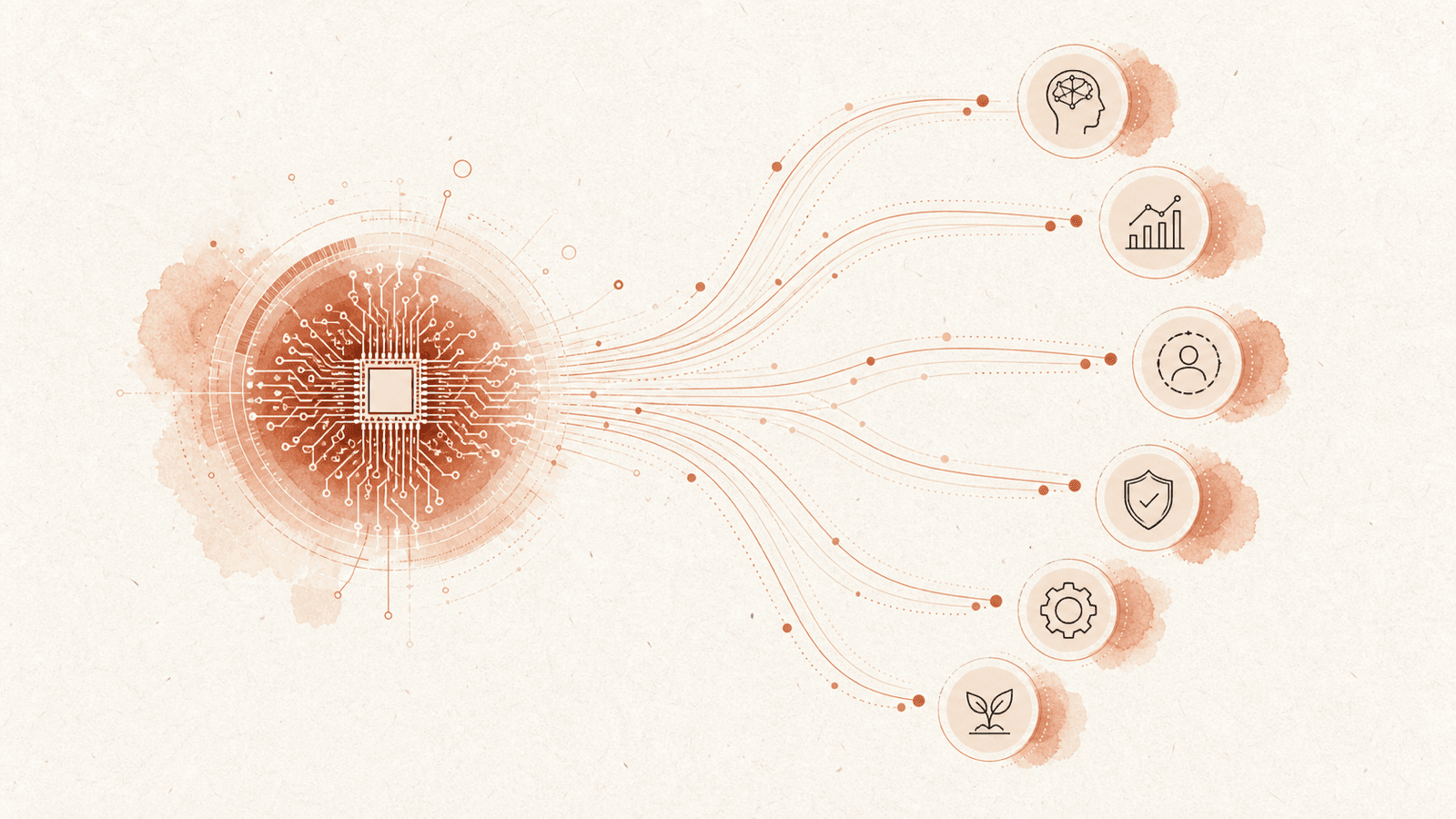
The "From AGI to ASI" report argues the most distinctive fact about AI is that we know its full algorithmic description (its code). From this single fact flow a set of advantages over biological intelligence (Table 1) that intensify with more/faster compute — meaning the human–AI capability gap widens as hardware improves, even where humans also benefit. The report's Summary Instructions explicitly ask summarizers not to compress this list, so it is preserved in full.
The six advantages (Table 1)#
- Input/output speed — AI ingests and emits information at increasingly high bandwidth (today's LLMs read multiple books in seconds); coupled to sensors/actuators, this means high-bandwidth world interaction.
- Internal processing speed — "thinking"/reasoning can be sped up with compute, sequentially (depth) or in parallel (breadth); a major scaling advantage even under diminishing returns.
- Working-memory capacity & memorization — AI working-memory size and read/write bandwidth can vastly exceed humans'; memorizing large parts of the internet is already demonstrated and likely far from the ceiling.
- Substrate independence — an AI can move from one computer to another, potentially at runtime (upgrading to faster/more-efficient hardware); even partial migration onto distributed heterogeneous hardware.
- Lossless replication — copy not just the source code ("DNA") but the memory state ("lifetime experience"); back up, restore, spawn, halt, and resume instances on demand.
- High-bandwidth sharing of (learning) experiences — digital I/O streams can be stored, shared, and replayed for training; among homogeneous instances, even raw learning signal (averaged gradients) can be shared. (Caveat: third-person observation can be causally insufficient for learning decision-making — Ortega et al. 2021.)
Why this makes AI "alien"#
These properties decouple AI from limits that shape human existence: an AI's lifespan isn't tied to its substrate; embodiment is flexible (virtual worlds, robot bodies, distributed swarms); it operates across far wider time/space scales (suspend for interstellar travel). Crucially, cultural evolution can run far faster — human culture passes through "low-bandwidth bottlenecks" requiring lossy compress/decompress (teaching, language), whereas AI collectives can share knowledge and even raw gradients directly. This points toward collective superintelligence and toward fast cultural/memetic self-improvement.
The one notable disadvantage#
The report flags an asymmetry worth naming: per N. Lawrence's "embodiment factor" (internal-processing capacity ÷ I/O rate), humans have a high embodiment factor — their communication bottleneck forces them to build deep internal models and hierarchies of abstraction. Digital intelligence, with high-bandwidth I/O, may not need (and so may not acquire) such coarse abstractions — a possible seed of the The Abstraction Barrier. Analog computation could also be more energy-efficient in principle.
Connections#
- Artificial Superintelligence (ASI) — these advantages are why the report argues progress won't stall at human level and why human intuitions break down for ASI
- Multi-Agent Collective Intelligence — lossless replication + high-bandwidth experience-sharing are what make scaling AI collectives cheap and tightly coordinated
- Intelligence Explosion Dynamics — high-bandwidth memetic/cultural evolution is one engine of super-exponential self-improvement
- The Abstraction Barrier — Lawrence's low-embodiment-factor argument is a mechanism by which high-bandwidth I/O could limit novel-concept formation
- Effective Compute Scaling — these advantages are precisely the ones that "scale with compute," so more effective compute widens the gap
Open Questions#
- Does training on human data suffice to give digital intelligence human-grade abstractions, or does the low embodiment factor cap concept formation? (The crux shared with The Abstraction Barrier.)
- What do ASI "societies" actually look like — homogeneous super-collectives, market ecologies, or compute-tethered virtual worlds?
Sources#
- From AGI to ASI — Section 3, Table 1 ("Advantages of digital over biological intelligence"); Lawrence (2024) on the embodiment factor
Cited by 7
- The Abstraction Barrier
Lerchner's hypothesis that AI trained on human concepts may be unable to discover genuinely novel conceptual primitives…
- Artificial Superintelligence (ASI)
DeepMind's informal characterization of ASI as a system that exceeds large, well-coordinated human-expert collectives a…
- Effective Compute Scaling
DeepMind's framing of compute growth as ~10×/year of 'effective compute' — the product of hardware improvement (~1.5×/y…
- Intelligence Explosion Dynamics
The growth-curve question behind recursive self-improvement: whether AI-accelerating-AI produces exponential, super-exp…
- LLM Architecture, Training & Alignment
Map of Content for the llm-architecture domain — 29 concepts. Curated entry point; see Home for all domains.
- Multi-Agent Collective Intelligence
DeepMind's fourth pathway to ASI: superintelligence as an emergent property of many coordinated AGI agents — group agen…
- Open Questions Backlog
_124 pages with open questions, as of 2026-06-19._
Related articles
- AGI-to-ASI Pathways
DeepMind's four non-exclusive, parallel technological routes from human-level AGI to superintelligence — scaling, algor…
- Fundamental Limits of ASI
Even far-superhuman AI is bound by hard physical (Landauer, Bremermann, Bekenstein, light-speed), complexity-theoretic…
- Universal AI (AIXI)
Hutter & Legg's formal upper bound on machine intelligence: AIXI, the incomputable agent optimal on average over all co…
- Intelligence Explosion Dynamics
The growth-curve question behind recursive self-improvement: whether AI-accelerating-AI produces exponential, super-exp…
- Multi-Agent Collective Intelligence
DeepMind's fourth pathway to ASI: superintelligence as an emergent property of many coordinated AGI agents — group agen…