Sources#
Summary#
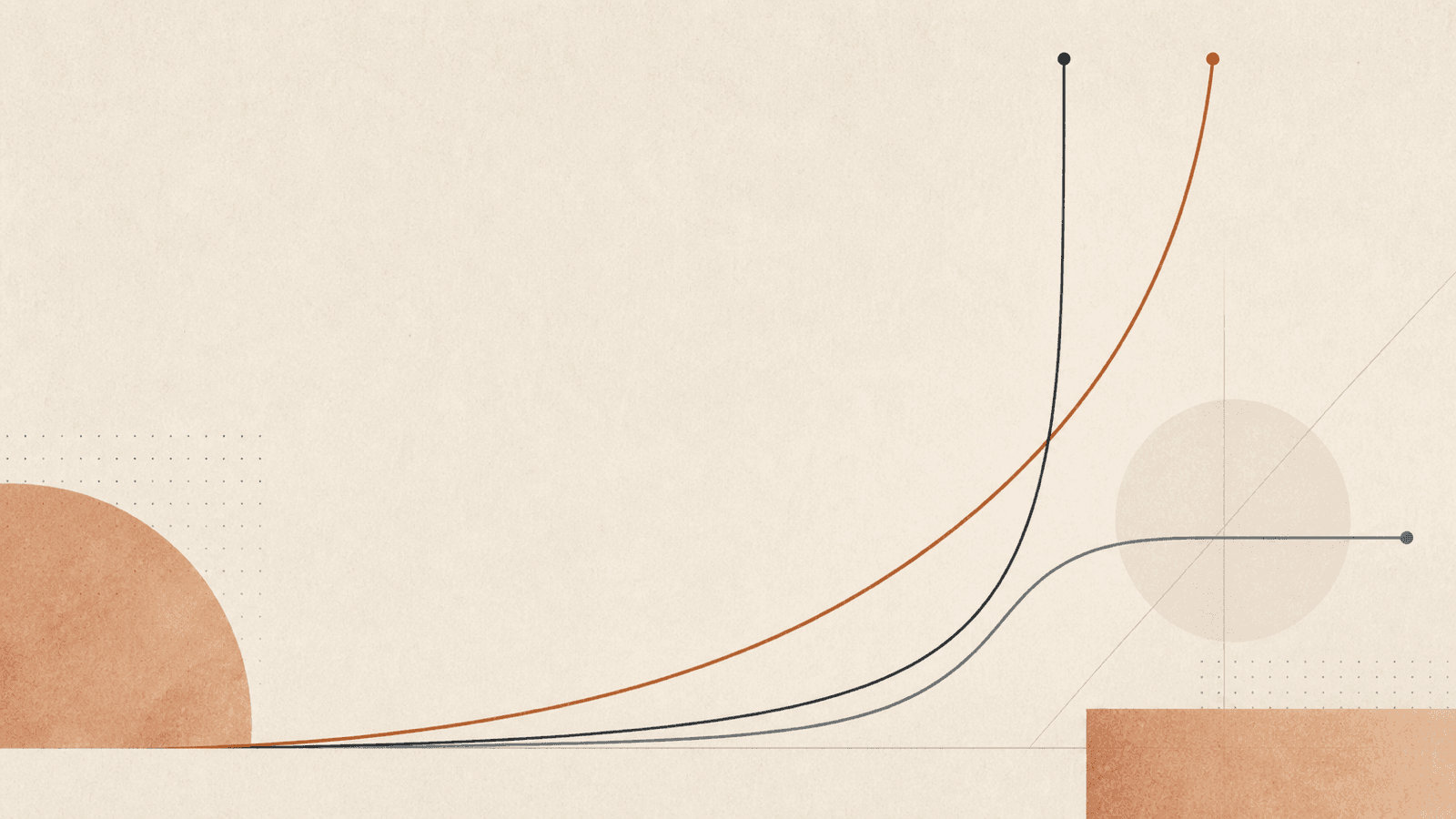
Where Recursive Self-Improvement names the mechanism (AI building its successor) and the pathways report places it as pathway 3, this page is about the growth dynamics — the shape of the curve. The "From AGI to ASI" report distinguishes three regimes and stresses that which one obtains is poorly understood and has no historic precedent to fit:
- Exponential — constant multiplicative growth rate (e.g. effective compute at ~10×/yr).
- Hyperbolic (super-exponential) — the growth rate itself increases with the quantity that grows; the characteristic property is infinite growth in finite time — a singularity. First raised for AI self-improvement by Solomonoff (1985); the basis of Kurzweil's "Singularity" and many fast-takeoff scenarios (Good 1965's "intelligence explosion", Bostrom, Chalmers, Davidson).
- S-curve — in natural finite systems, frictions and boundary conditions bend growth down before a singularity. For AI-research automation, "the point at which these frictions kick in is unknown."
The feedback loop#
If AI speeds up AI research, that progress yields faster/more-capable/more-numerous AI, which speeds research further — a positive feedback loop. The most dramatic dynamics (potentially hyperbolic) arise if AI research is fully automated, but weaker recursive effects are already in play (e.g. "thinking" models curating better training data; neural architecture search; AI-assisted hardware design). The report's working judgment: it is a strong assumption that hundreds of thousands to millions of artificial researchers would have negligible impact — so unless progress halts first, recursive improvement is likely at least a significant accelerant.
Four mechanisms (mapped to human evolution)#
The report maps recursive-improvement flavors onto the engines of human capability growth — AI may run each far faster:
- Genetic (genotypic RSI) — improving the "blueprints": code (architectures, optimizers, harnesses) and hardware designs. Slow for humans; potentially very rapid for self-modifying AI.
- Cultural (memetic RSI) — improving intellectual artifacts: automated dataset curation, synthetic data, AlphaZero-style recursive distillation, tool formation. Human cultural evolution drove the last 50,000 years; AI's could be much faster given how fast artifacts are produced/shared/consumed.
- Cooperative (sociogenic RSI) — division of labor: specialization frees resources → larger collectives → further specialization. Requires cooperation; its weight for AI collectives is unclear (today's models specialize instantly via prompting). See Multi-Agent Collective Intelligence.
- Data — AI curating/generating/simulating higher-quality datasets for the next generation (the AlphaZero distill-search-back-into-prior loop). The economic pressure to harvest test-time-compute returns from billions of users makes this concrete.
Formal barriers & what dampens the explosion#
- Schmidhuber's Gödel machines formalize provably-optimal self-modification but require complete self-knowledge and are limited by Gödel's incompleteness (see Fundamental Limits of ASI).
- Christiano's iterated amplification — capability bootstrapping while preserving alignment by recursive task decomposition.
- Physical & real-time brakes — even superhuman-speed digital researchers must run experiments and wait for outcomes; anything requiring physical manipulation (better chips, wet-lab validation) can't be sped up arbitrarily. This is the embodied bottleneck and the report's main argument against an unbounded singularity. Iterated recursion also tends to plateau (diminishing returns, cf. AlphaZero) or degenerate (training on self-generated data).
The report's overall low-confidence read: a hard plateau exactly at AGI is unlikely; more probable is either a pre-AGI plateau or a relatively smooth AGI→weak-ASI transition — unless recursive improvement produces dramatic acceleration, which "cannot be ruled out" and would make the transition rapid.
Connections#
- Recursive Self-Improvement — the mechanism; this page is its growth-dynamics complement (Anthropic's When AI builds itself is the sibling source)
- AGI-to-ASI Pathways — recursive improvement is pathway 3; the report treats its dynamics as the largest forecasting uncertainty
- Effective Compute Scaling — exponential compute growth is the substrate a recursive loop bends upward; data-as-RSI overlaps the data-wall counters
- Multi-Agent Collective Intelligence — cooperative/sociogenic RSI is collective specialization compounding
- Advantages of Digital Intelligence — high-bandwidth memetic/cultural evolution (lossless experience-sharing) is one engine of super-exponential self-improvement
- The Abstraction Barrier — the embodied bottleneck converts a would-be hyperbolic loop into one paced by empirical science
- Fundamental Limits of ASI — Gödel/physics/real-time limits are what bound the explosion
- AI-Driven Formal Proof Search — FunSearch/AlphaEvolve are concrete algorithmic self-improvement (LLM-guided program search finding novel constructions)
- Task Time-Horizon Scaling — the trendline that makes "is the curve bending?" empirically checkable
- AI R&D Autonomy Evaluation (AECI) — measuring the extent of AI-R&D automation (Chan et al. 2026; Anthropic's AECI) is the empirical input a "recursive improvement scaling law" would need
- Artificial Superintelligence (ASI) — whether the AGI→ASI transition is smooth or explosive is what these growth regimes decide
Open Questions#
- Can "recursive improvement scaling laws" be formulated — predicting self-improvement curves (and their plateau point) from early-onset datapoints?
- How far can a fixed model's performance be pushed with test-time search alone, and under what conditions does recursive distillation degenerate vs. compound?
- Which binds first — algorithmic ceilings, the embodied bottleneck, or compute/energy supply — determining exponential vs. hyperbolic vs. S-curve? Synthesized: RSI Growth Curves: Which Friction Binds First? — both this report and Anthropic's locate the binding constraint outside cognition (the slowest un-acceleratable step coupling the loop to reality); the embodied bottleneck re-paces rather than halts, data-wall/research-harder demote into compute, and the abstraction barrier is the one candidate fundamental blocker.
Sources#
- From AGI to ASI — Section 2 ("Is the Singularity near?"), Section 5.3 (recursive self-improvement, four mechanisms), Section 7.1 (research agenda item 4)
Cited by 14
- The Abstraction Barrier
Lerchner's hypothesis that AI trained on human concepts may be unable to discover genuinely novel conceptual primitives…
- Advantages of Digital Intelligence
The six properties (Table 1) that follow from knowing an AI's source code — I/O speed, processing speed, working memory…
- AGI-to-ASI Pathways
DeepMind's four non-exclusive, parallel technological routes from human-level AGI to superintelligence — scaling, algor…
- AI-Driven Formal Proof Search
LLM generates Lean, compiler verifies every step → eliminates hallucination; DeepMind resolves 9/353 Erdős + 44/492 OEI…
- AI R&D Autonomy Evaluation (AECI)
How Anthropic measures whether a model can automate or dramatically accelerate AI research — the capability that drives…
- Artificial Superintelligence (ASI)
DeepMind's informal characterization of ASI as a system that exceeds large, well-coordinated human-expert collectives a…
- Effective Compute Scaling
DeepMind's framing of compute growth as ~10×/year of 'effective compute' — the product of hardware improvement (~1.5×/y…
- Fundamental Limits of ASI
Even far-superhuman AI is bound by hard physical (Landauer, Bremermann, Bekenstein, light-speed), complexity-theoretic…
- Governance & Workforce
Map of Content for the governance-workforce domain — 16 concepts. Curated entry point; see Home for all domains.
- Multi-Agent Collective Intelligence
DeepMind's fourth pathway to ASI: superintelligence as an emergent property of many coordinated AGI agents — group agen…
- Open Questions Backlog
_124 pages with open questions, as of 2026-06-19._
- Recursive Self-Improvement
An AI system autonomously designing and developing its own successor; Anthropic Institute's *When AI builds itself* arg…
- RSI Growth Curves: Which Friction Binds First?
DeepMind's exponential/hyperbolic/S-curve growth shapes are Anthropic's compounding-efficiency/full-RSI/stalled futures…
- Task Time-Horizon Scaling
METR's measure of the task length AI can complete reliably on its own, doubling roughly every 4 months (up from every 7…
Related articles
- AGI-to-ASI Pathways
DeepMind's four non-exclusive, parallel technological routes from human-level AGI to superintelligence — scaling, algor…
- Multi-Agent Collective Intelligence
DeepMind's fourth pathway to ASI: superintelligence as an emergent property of many coordinated AGI agents — group agen…
- Universal AI (AIXI)
Hutter & Legg's formal upper bound on machine intelligence: AIXI, the incomputable agent optimal on average over all co…
- Autonomous Scientific Discovery
Mythos-class models now conduct novel science with limited human input — autonomous protein/drug design (~10× faster, m…
- Effective Compute Scaling
DeepMind's framing of compute growth as ~10×/year of 'effective compute' — the product of hardware improvement (~1.5×/y…