Sources#
Question#
Anthropic's When AI builds itself (Recursive Self-Improvement) lays out three RSI futures. DeepMind's From AGI to ASI (AGI-to-ASI Pathways) lays out three growth shapes plus six frictions (Intelligence Explosion Dynamics). Reconcile the two framings, and answer the question both reports raise but neither directly answers: which friction binds first — i.e., what actually bends the curve, and when?
The short answer#
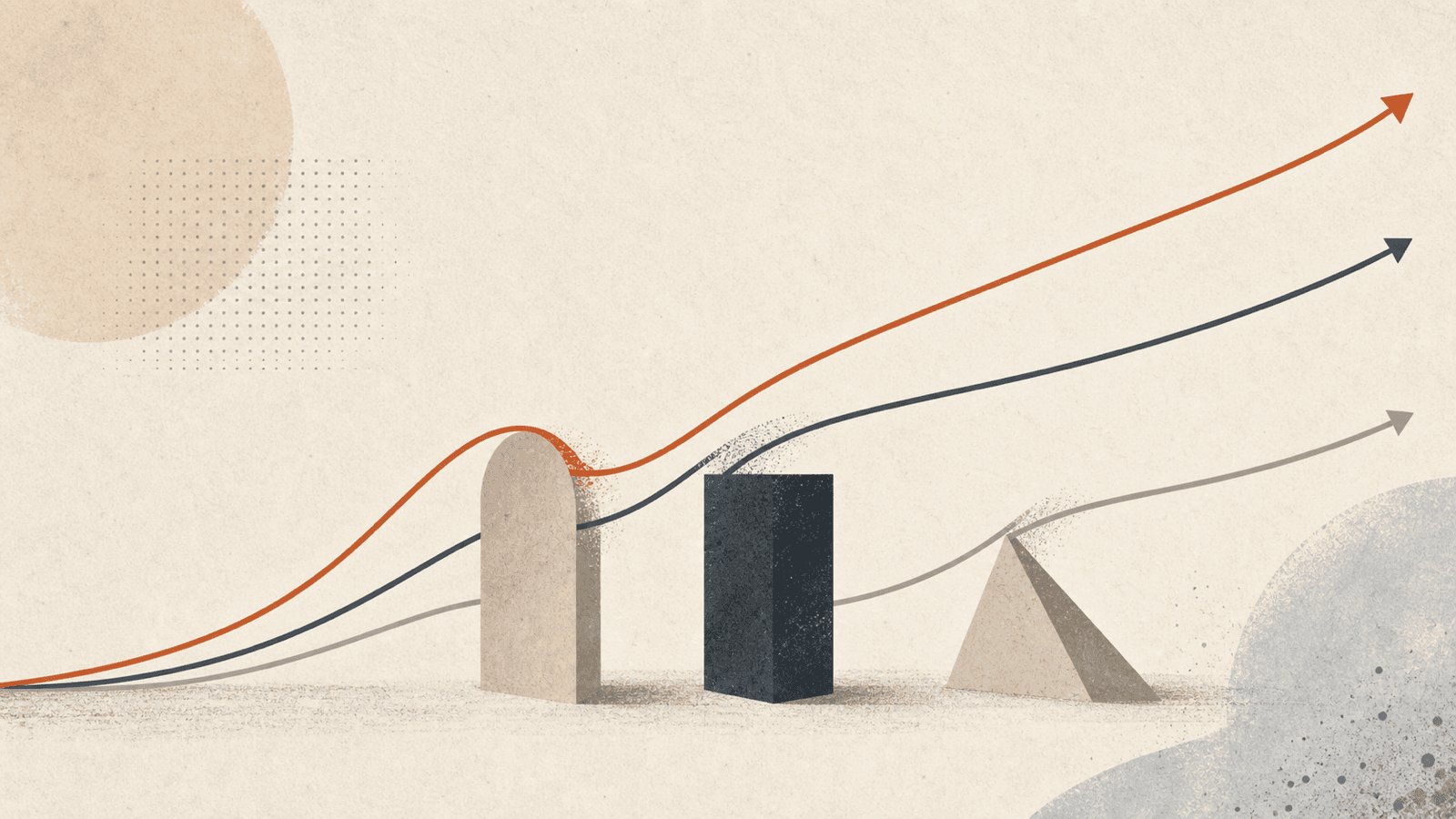
The two framings are one trichotomy described twice — Anthropic from the policy/role side (what humans end up doing), DeepMind from the dynamics/math side (the shape of the curve). They agree on the menu and disagree only on whether to rank it: Anthropic assigns likelihoods; DeepMind refuses to, calling each friction's weight "an open research question."
On "which binds first," both labs — using different vocabulary — converge on the same structural insight: the pace is set by the slowest step you cannot accelerate, and that step is not cognition. The model's thinking is the cheapest input in the loop and is racing (Anthropic: "we have not yet seen that curve bend"). The binding friction is the loop's coupling to reality — verification/oversight at organizational scale today, and physical-experiment + institutional latency at the ASI frontier. Anthropic calls this Amdahl's law; DeepMind calls it the embodied bottleneck. They are the same argument.
One trichotomy, two framings#
DeepMind's three growth regimes map almost exactly onto Anthropic's three futures — note the inverted ordering of likelihood and the swapped viewpoint:
| DeepMind growth shape | = Anthropic future | What it means | Anthropic's odds |
|---|---|---|---|
| S-curve — frictions bend growth down before any singularity | Future 1: trend stalls, capabilities diffuse | The judgment gap doesn't yield to scaling; or supply chain / a post-Transformer architecture is the wall. World still transforms at frozen capability. | Unlikely — "we have not yet seen that curve bend" |
| Exponential — constant multiplicative growth, bounded | Future 2: compounding efficiency, humans set direction | AI R&D substantially automated; humans judge results; capped by Amdahl's law (bottleneck-shifting). | Likely |
| Hyperbolic — growth rate rises with the quantity; singularity in finite time | Future 3: full RSI, pace set by compute | The loop closes; humans move to oversight of an expanding "virtual lab." Alignment outcome is what Anthropic is "least certain about." | Not ruled out; most uncertain |
The viewpoint swap is the useful part. Anthropic's futures are indexed by the human role (do humans still set direction? still review?); DeepMind's regimes are indexed by the curve's second derivative. They are the same three worlds because the human role is exactly what the un-acceleratable friction protects — humans remain load-bearing precisely on the steps the loop can't speed up.
The frictions are the bend-mechanisms#
DeepMind's six frictions are the candidate mechanisms that would push the curve hyperbolic → exponential → S-curve. Anthropic names a smaller, organizationally-framed set of brakes; they are a compression of DeepMind's list:
| DeepMind friction | Anthropic's corresponding brake | Both labs' read on whether it binds |
|---|---|---|
| Data wall (Effective Compute Scaling) | (folded into "supply chain" in Future 1) | Demoted by both — synthetic/simulated/distilled-back data scales with compute (AlphaZero loop); "friction, not a fundamental blocker" |
| Research gets harder (Bloom et al.) | The thing Anthropic's evidence directly refutes | Demoted by both — "cheap artificial researchers" multiply 20× in hours, not years; Anthropic's 8× code / engineer is this friction failing to bind |
| Economic & resource demand | "Supply chain — energy, chip fab, grid, interconnect" (Future 1) | Conditional — binds hard if progress needs raw scaling; marginal if it comes from algorithmic efficiency. Pathway-dependent. |
| Neural paradigm insufficient | "May require a new architecture past the Transformer" (Future 1) | Conditional / wildcard — if the judgment separating good from great researchers can't come from scaling, Future 1 obtains |
| Abstraction barrier (The Abstraction Barrier) | (no clean Anthropic analogue) | DeepMind's candidate for a fundamental blocker — and it re-paces rather than halts: see below |
| Deliberate slowdown (Frontier Pause Verification) | The entire governance response (build pause-verification) | The inversion — the one friction Anthropic wants to install; the one DeepMind doubts can be made to bind |
Which binds first — the tiered verdict#
Neither report ranks. But synthesizing the two yields a defensible ordering by when each friction actually starts to bite:
1. Already binding (organizational scale, mid-2026). The Amdahl's-law / verification-and-oversight coupling. Anthropic has already hit it: as more code flowed through the org, human code review became the new bottleneck (Verification as the New Bottleneck). This is the empirically-real first friction — not a forecast. Critically, it is the organizational instance of DeepMind's embodied bottleneck: the part of the loop that doesn't speed up sets the pace.
2. The deepest, most-likely frontier friction (both reports' convergent argument). The loop's coupling to physical and institutional reality. DeepMind: the embodied bottleneck — novel concepts must be validated against physical reality, so the intelligence-growth rate is gated to "the rate of empirical science" rather than the rate of compute. Anthropic: RSI "can't run clinical trials faster than biology, hold elections sooner than constitutions allow, or turn a stranger into an old friend in a weekend." Same shape of argument, two domains (physical-experiment latency vs. social/institutional latency). This is what most plausibly converts a hyperbolic curve into a merely-exponential one — Future 3 into Future 2.
3. The fundamental wildcard. The The Abstraction Barrier in its strong form — if AI trained on human concepts genuinely cannot discover novel primitives (can't reason to general relativity from pre-Newtonian data), then research taste is a real ceiling, not the next capability to fall, and the S-curve / Future 1 obtains. DeepMind flags this as the friction "most likely to be a fundamental blocker." Anthropic's Future 1 names the same possibility ("a new architecture past the Transformer") but, lacking the mechanistic story, rates it unlikely because the curve hasn't bent yet. The live test is Autonomous Scientific Discovery: do the June 2026 wet-lab results cross the barrier or just operate fast within human-defined spaces?
4. Demoted by both. Data wall and research-gets-harder. Both are absorbed by compute itself — synthetic data and cheap digital researchers scale on the same exponential they're supposed to constrain. Anthropic's measured 8× throughput is the research-gets-harder friction visibly failing to bind.
5. The friction humans must choose. Deliberate slowdown is the only exogenous item on the list — the only one not handed down by physics or economics. This is the sharpest lab divergence: Anthropic's entire governance agenda exists to make this friction bind (Frontier Pause Verification), precisely because it suspects the endogenous frictions (especially in Future 3) won't bind soon enough or hard enough. DeepMind is pessimistic it can be made to bind: under "military–economic adaptationism" and international anarchy, multilateral coordination is "elusive, perhaps unrealistic." So the friction Anthropic is most determined to engineer is the one DeepMind is most doubtful is engineerable.
Where the two labs genuinely diverge#
- Ranking vs. refusal. Anthropic commits (Future 2 likely, Future 1 unlikely, Future 3 not ruled out). DeepMind declines on principle — point-predicting past a paradigm shift is "vacuous," so it advances paradigm-agnostic theory (Universal AI (AIXI)) instead of forecasts. This is a methodological split (empirical-first vs. theory-first), not a factual disagreement.
- The concept-discovery ceiling. DeepMind contributes the one mechanism Anthropic lacks — a reason taste might be a true ceiling (the abstraction barrier), versus Anthropic's empirical "we haven't seen it bend." This is the single most decision-relevant addition the cross-lab synthesis produces.
- The slowdown inversion (above): the friction Anthropic treats as a deliverable is the one DeepMind treats as nearly unattainable.
Bottom line#
"Which friction binds first" dissolves once you notice both reports locate the binding constraint outside the model's cognition. Intelligence is the cheap, racing input; the pace-setter is whatever couples the loop to a reality that can't be sped up — code review and human oversight already (Amdahl, today), physical experiment and institutional latency at the frontier (the embodied bottleneck, tomorrow). The data wall and the harder-ideas friction get absorbed by compute and so demote themselves. The genuine open questions are narrower than the six-friction menu suggests: (a) is the abstraction barrier a real concept-discovery ceiling (→ Future 1) or just slow validation (→ Future 2)? and (b) can the one friction humans actually control — deliberate slowdown — be made to bind before the endogenous ones fail to?
Sources#
- When AI builds itself — Anthropic Institute (Favaro & Clark, June 2026): three futures, Amdahl's law, "curve hasn't bent." Via Recursive Self-Improvement, AI Accelerating AI Development.
- From AGI to ASI — Google DeepMind (Genewein, Hutter, Legg et al., arXiv 2606.12683): three growth regimes, six frictions, the abstraction barrier and embodied bottleneck. Via AGI-to-ASI Pathways, Intelligence Explosion Dynamics, Effective Compute Scaling, The Abstraction Barrier.
- Research Taste as the Human Bottleneck — the human comparative advantage the un-acceleratable frictions protect.
- Frontier Pause Verification — the deliberate-slowdown friction as a governance deliverable.
Cited by 4
- AGI-to-ASI Pathways
DeepMind's four non-exclusive, parallel technological routes from human-level AGI to superintelligence — scaling, algor…
- Intelligence Explosion Dynamics
The growth-curve question behind recursive self-improvement: whether AI-accelerating-AI produces exponential, super-exp…
- Open Questions Backlog
_124 pages with open questions, as of 2026-06-19._
- Recursive Self-Improvement
An AI system autonomously designing and developing its own successor; Anthropic Institute's *When AI builds itself* arg…
Related articles
- Multi-Agent Collective Intelligence
DeepMind's fourth pathway to ASI: superintelligence as an emergent property of many coordinated AGI agents — group agen…
- Open Questions Backlog
_124 pages with open questions, as of 2026-06-19._
- Recursive Self-Improvement
An AI system autonomously designing and developing its own successor; Anthropic Institute's *When AI builds itself* arg…
- Task Time-Horizon Scaling
METR's measure of the task length AI can complete reliably on its own, doubling roughly every 4 months (up from every 7…
- AGI-to-ASI Pathways
DeepMind's four non-exclusive, parallel technological routes from human-level AGI to superintelligence — scaling, algor…