Sources#
Summary#
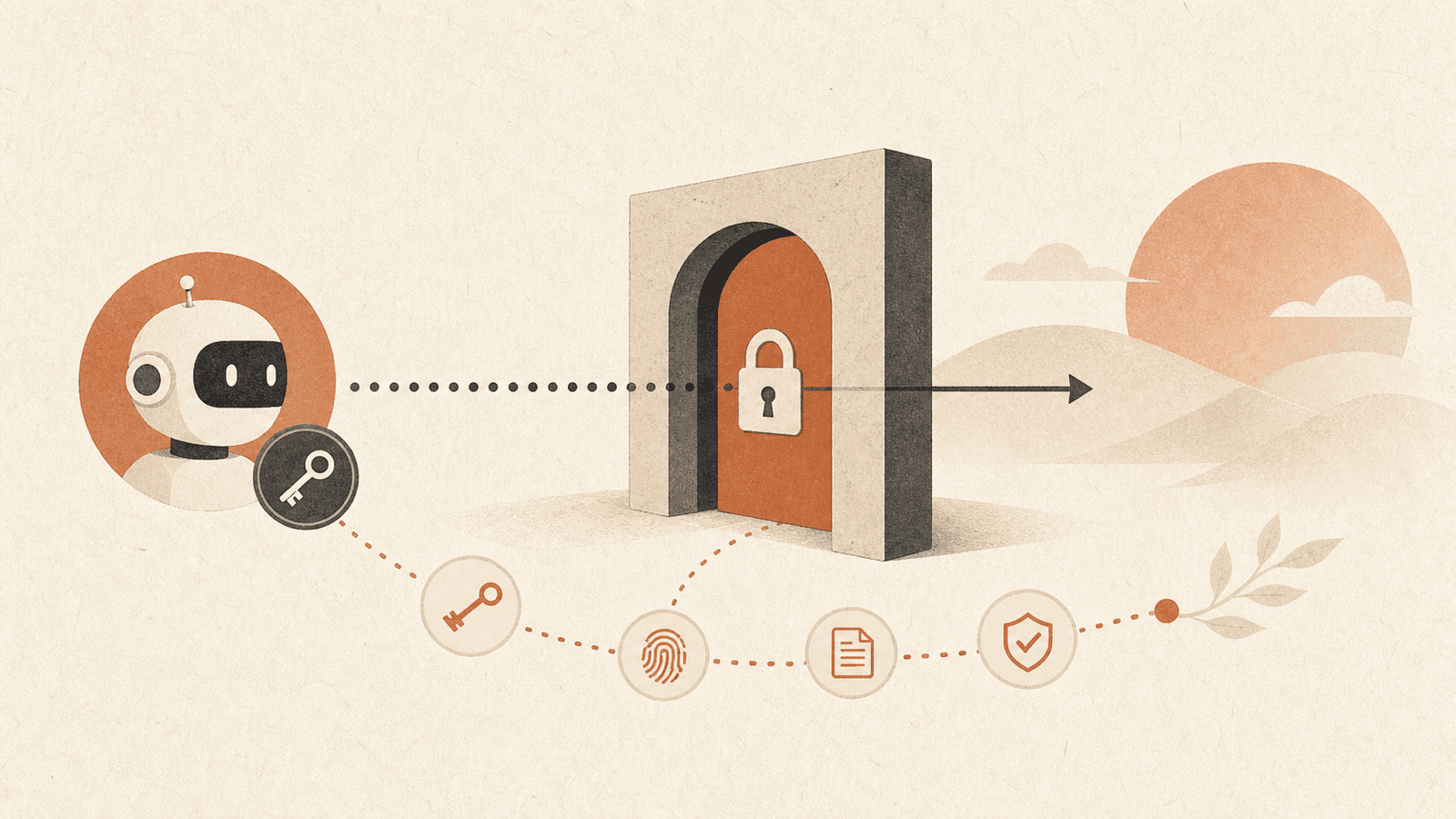
Identity and authentication form the foundation for every other security capability in Zero Trust for AI Agents: without verifiable identity you cannot enforce access controls, maintain audit trails, or attribute actions. Without distinct identities, agents operate in an "attribution gap" where enforcing Least Agency becomes impossible. The framework's stance is aggressive — static API keys and shared service-account passwords are "among the first things an attacker with model-assisted code analysis will find" and are no longer acceptable even at Foundation.
Two halves: who you are, and proving it#
Agent identity verification#
- Foundation — unique cryptographically-rooted identifiers per agent instance (not just labels — "unique identifiers alone are a labeling exercise"); lifecycle tracked creation→retirement; IDs in all logs and access requests. Cryptographic rooting is what makes non-repudiation and identity-forgery-resistance real.
- Enterprise — X.509 certificates with full lifecycle management (rotation, revocation).
- Advanced — hardware-backed identity in HSMs/TPMs with remote attestation; increasingly recommended as the target state for any internet-reachable production system.
Service authentication#
- Foundation — short-lived, narrowly-scoped tokens from an identity provider (OAuth 2.0), expiry in minutes, automated refresh, never embedded in code/config. Running API keys with rotation "today" is a known gap, not a legitimate Foundation posture — rotating a greppable credential doesn't meaningfully raise cost (see Impossible, Not Tedious (Design Test)).
- Enterprise — mutual TLS with certificate pinning.
- Advanced — hardware-bound credentials with attested issuance, so credentials can't be exfiltrated from a compromised host; applies to service-to-service calls too.
Credential protection and scoping (Phase 6)#
- Credential isolation — per-agent unique credentials so one theft doesn't grant the combined access of every agent sharing a secret; inject at runtime from secrets managers (e.g., HashiCorp Vault), never in code/config.
- Just-in-Time (JIT) access — grant permissions only at the moment of need, scoped and time-boxed, auto-revoked; an attacker finds no cached credentials to steal. The framework calls JIT "very powerful, not easily implemented" — an advanced but very strong mitigation.
- Attribute-based access control (ABAC) — evaluate identity, resource sensitivity, action, time, location, risk score before granting; step-up auth for sensitive records, block bulk exports.
- Hardware-bound 2FA — FIDO2 / passkeys wherever a human is in the loop; SMS codes "do not meet the Foundation bar."
Why this is the keystone#
Identity is the prerequisite for Blast Radius (Agentic) containment (identity-based isolation: services accept only explicitly-named callers), for Least Agency enforcement (you can't scope what you can't attribute), and for observability/traceability (filtering audit logs by agent during an incident). The framework notes Claude Code assigns a unique session.id with account_uuid/organization.id attribution on all telemetry, and uses OAuth 2.0 with auto-refresh for MCP connections.
Connections#
- Zero Trust for AI Agents — control domain 1; the foundation for every other control (hub)
- Least Agency — unenforceable without distinct per-agent identity (the attribution gap)
- Blast Radius (Agentic) — identity-based isolation and per-agent credentials are the primary containment controls
- Impossible, Not Tedious (Design Test) — static-key rotation is a friction control that fails; short-lived + hardware-bound credentials pass
- Claude Code — cited reference: per-session identity, OAuth 2.0 MCP auth, OS credential store,
apiKeyHelper - MCP and Computer Use — MCP connections are a named place to apply short-lived IdP-issued tokens over static keys
- Autonomous Defense — automated incident response (quarantine, session termination, credential revocation) executes through the identity-based isolation and short-lived credentials defined here
- Foundation → Enterprise → Advanced: Is the Agent Access-Control Jump a Cliff? — the Foundation→Enterprise→Advanced migration path across identity, least-agency, and blast-radius; answers the cliff-vs-midpoint open question below
Open Questions#
- Hardware-bound credentials assume attested hardware everywhere agents run, including ephemeral cloud workloads and sub-agents. How does attestation work for short-lived spawned sub-agents that "have up to the same permissions as the parent"?
- JIT + ABAC are both labeled "advanced, not easily implemented." Is there a pragmatic Enterprise-tier midpoint, or is the gap from Foundation static roles to Advanced JIT a cliff? Answered: Foundation → Enterprise → Advanced: Is the Agent Access-Control Jump a Cliff? — not a cliff; the Enterprise tier (ABAC + dynamic privilege elevation with return-to-baseline + mTLS + sandboxing) is the deliberate midpoint, and ABAC's "advanced" framing is a source inconsistency (it sits at Enterprise in the tier table). Sub-agent attestation remains open.
Sources#
- Zero Trust for AI Agents — Part III identity/auth + access-control tiers; Part IV Phases 3 & 6
Cited by 9
- Foundation → Enterprise → Advanced: Is the Agent Access-Control Jump a Cliff?
No cliff — Enterprise (ABAC + dynamic privilege elevation with return-to-baseline + mTLS + sandboxing) is the pragmatic…
- Autonomous Defense
Running security operations at the speed of AI-accelerated threats: put a model at the front of the alert queue, automa…
- Blast Radius (Agentic)
The potential damage if an agent is compromised; the unit Zero Trust's 'assume breach' posture is built to contain via…
- Claude Code
Anthropic's agentic coding product; created by Boris Cherny late 2024; TypeScript/React; CLI/desktop/web/mobile/IDE sur…
- Least Agency
OWASP term extending least privilege to agents: constrain not just what an agent can access but what each tool can do,…
- MCP and Computer Use
Anthropic's two complementary connector mechanisms: MCP for structured programmatic access (Salesforce/Drive/Gmail/Slac…
- AI Engineering & Agent Tooling
Map of Content for the ai-engineering domain — 45 concepts. Curated entry point; see Home for all domains.
- Open Questions Backlog
_124 pages with open questions, as of 2026-06-19._
- Zero Trust for AI Agents
Anthropic's security framework for deploying autonomous agents: trust nothing / verify everything / assume breach, appl…
Related articles
- Least Agency
OWASP term extending least privilege to agents: constrain not just what an agent can access but what each tool can do,…
- Zero Trust for AI Agents
Anthropic's security framework for deploying autonomous agents: trust nothing / verify everything / assume breach, appl…
- Blast Radius (Agentic)
The potential damage if an agent is compromised; the unit Zero Trust's 'assume breach' posture is built to contain via…
- Agentic Prompt Injection
Direct and indirect injection of malicious instructions into an agent; LLMs cannot reliably distinguish information fro…
- Claude Code Best Practices
Anthropic's guide to effective Claude Code usage: context management, verification-driven development, explore→plan→cod…