Sources#
- OpenAI Codex lead on the new shape of product work
- The Founder's Playbook: Building an AI-Native Startup
Summary#
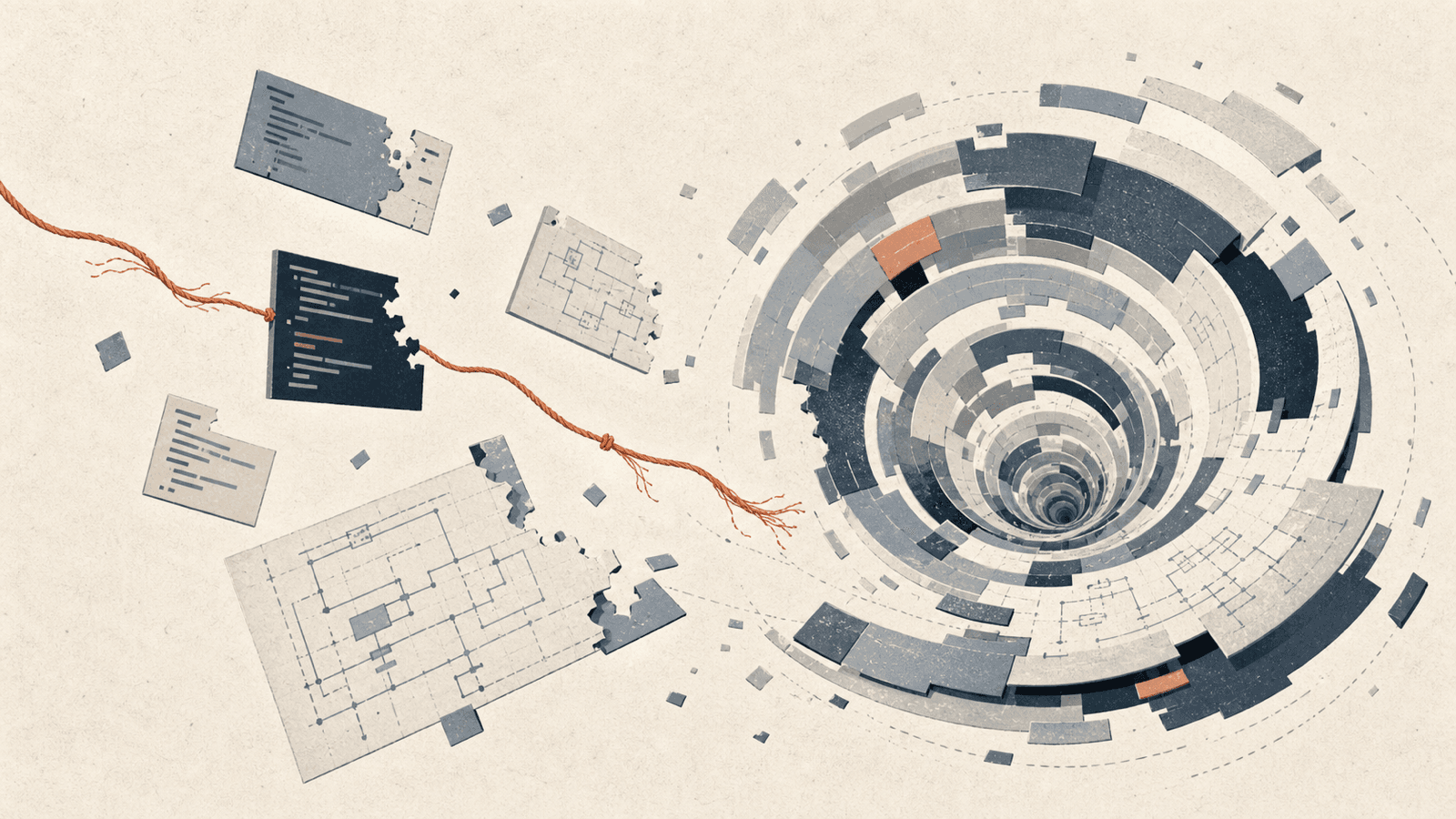
A specific failure mode of AI-built codebases articulated in The Founder's Playbook: Building an AI-Native Startup: technical debt that compounds rather than accumulates linearly, because each agentic-coding session re-derives foundational architectural decisions from scratch when no persistent specs or context files exist. The result is a codebase that is functional in pieces but has "no coherent mental model behind it, not because any single piece is bad, but because the pieces were never designed to fit together." The problem tends to surface late — the codebase runs fine until iteration or scale forces a full rewrite.
Why this is different from ordinary technical debt#
Ordinary debt accumulates gradually and can be cleared in a dedicated sprint. Engineers know the shortcuts they took and where; the work is bounded.
Agentic technical debt has three structurally novel properties:
- Drift, not just shortcut. Each session's "first principles" reasoning lands in a slightly different place. The codebase doesn't just contain compromises; it contains inconsistencies between compromises.
- Invisible until it isn't. A working feature does not advertise the architectural premise it was built against. The drift is observable only by reading the whole codebase, which the founder typically isn't doing because they're shipping.
- No natural feedback loop. A traditional engineering team has shared design conversations, code review, ADRs — all of which create human memory of "why this way." A solo founder + agent has neither, so each session genuinely starts from zero on intent.
The mechanism#
"Without specs and architectural constraints written down somewhere the AI can read, each session re-derives foundational decisions from scratch, and those decisions drift."
Each agentic session begins with the agent inferring its own structural assumptions from the current code state. Two sessions reading the same code can infer two different intents (was this pattern intentional? Was that abstraction a constraint or a coincidence?). The agent then builds the next feature against its inferred intent. Repeat over months and the codebase contains multiple "implicit architectures" interleaved.
The remedy: persistent context#
The playbook's prescription is to encode architectural intent in CLAUDE.md markdown files that Claude Code automatically reads at the start of every session. These files serve as project-level instructions — functionally persistent "memory" for the project. The discipline:
- Before opening Claude Code, open Claude (chat) and define what you're building: core problem, users, six-month scale, architectural principles, dependencies to avoid, tradeoffs being consciously accepted. Save as CLAUDE.md.
- Start each Claude Code session by (1) revisiting the scope document and (2) providing the model with the CLAUDE.md context document.
- End each session by updating CLAUDE.md with any decisions the session surfaced.
The playbook's claim: "Five minutes of documentation per session is cheap insurance against architectural drift that compounds into an unmanageable codebase."
When the debt matures#
The playbook flags two moments when ordinary AI-built debt becomes a structural liability:
- MVP → Launch transition. Production traffic, new features, and growing complexity expose shortcuts. "That debt starts accruing interest, and the longer it goes unaddressed, the more expensive it is to fix."
- Pre-enterprise audit. Enterprise contracts surface compliance requirements (SOC 2, GDPR, HIPAA) that didn't apply to a prototype. AI scans help but are explicitly not a substitute for qualified compliance review.
The Launch-stage remedy is a systematic architectural audit (Claude Code finds structural weaknesses, test-coverage gaps, refactoring candidates) → Claude triages and sequences remediation → CLAUDE.md is updated with the architectural decisions that lived only in the founder's head during MVP.
The "rebuild from scratch" failure mode#
"Letting Claude Code build without guardrails produces a codebase that will be functional but structurally incoherent, and iterating on and scaling incoherent codebases is ultimately a waste of time and tokens. Sooner or later there's a point where the code inevitably collapses, forcing you to rebuild from scratch."
The economic argument: iterating on incoherent code costs more tokens (longer context, more re-reading, more clarification) than maintaining a coherent codebase from the start. The cost is not principally human time — it's compute. Founders chasing zero-cost iteration trade present minutes for future cost-of-rewrite.
Connections#
- AI-Native Startup Lifecycle — primary MVP and Launch-stage hazard
- Deep Modules for Agents — Ousterhout-style deep modules + persistent-context discipline are the architectural counter-pressure; Matt Pocock's Sandcastle pattern is one concrete instance
- Claude Code Best Practices — official Anthropic guidance on CLAUDE.md; the playbook frames the same discipline as founder survival, not best practice
- Claude Code — the tool where this debt accumulates
- Zero-Friction Scope Creep — companion failure mode; scope creep accrues debt faster
- Harness Shrinkage as Models Improve — counter-pressure: if the harness (including session-context plumbing) shrinks, CLAUDE.md may need to evolve too
- Context Window Smart Zone — CLAUDE.md must fit in the smart zone; over-long context files become their own problem
- Design Concept Grilling — Matt Pocock's grill-me pattern reaches a Brooks "design concept" before code, complementary to CLAUDE.md-as-architectural-context
- Founder as Agent Orchestrator — non-technical founder pipeline raises the stakes: the founders most able to identify problems are least equipped to author the architectural context that prevents this debt
- Problem-Solution Fit Discipline — the twin MVP-stage hazard; epistemic discipline (validate before building) and architectural discipline (persist context before building) are both load-bearing
- Agentic Work Systematization — un-systematized agent use is the re-derive-from-zero / intent-debt failure mode; skills are the persistent-context antidote — but rotting, unmaintained skills are themselves a debt surface as conventions drift
Open questions#
- How long does a CLAUDE.md remain accurate as a codebase evolves? The playbook gestures at session-by-session updates; no data on rot rate.
- The remedy assumes the founder is able to articulate architecture in plain language. Non-technical founders (the playbook's headline beneficiary group) may have neither the vocabulary nor the intuition to do this well — a recursion failure the playbook doesn't address.
- Anthropic's harness-shrinkage thesis suggests CLAUDE.md may eventually be inferred by the model itself. Until then, the discipline is load-bearing.
Connections#
- Code as Source of Truth — Fiona Fung's positive program against this debt: check specs/skills into the repo so context stays current and Claude can verify spec drift, instead of each session re-deriving it
- Harness Shrinkage as Models Improve — CLAUDE.md is a harness asset that may eventually be inferred; until then, persistent context is the antidote to compounding debt
- Founder as Agent Orchestrator — the recursion problem: non-technical founders may lack the vocabulary to write effective CLAUDE.md
- Loop Engineering — Osmani's intent debt is the same compounding-drift mechanism viewed from the loop: without skills a loop "re-derives your whole project from zero every cycle," each session filling intent gaps with a confident guess; skills (intent written outside) are the antidote, exactly as CLAUDE.md is here
- Outsource Your Thinking, Not Your Understanding — the cognitive twin: comprehension debt (the gap between code-that-exists and what-you-understand) is this architectural debt in the understanding register, and both compound at agentic-coding speed
- Acceleration Whiplash — the same compounding mechanism measured at industry scale; Faros AI's "context engine" (intent derived from how the codebase evolved, not its current state) is the org-scale version of the CLAUDE.md remedy
- AI as Primary Author — an AI author with no persistent intent re-derives architecture each session; this debt is the structural cost of that authorship/accountability gap
- Andrew Ambrosino — the frontier-lab report of the complexity-ratchet: models add code, are bad at deleting, blocking unsupervised development
- Vibe Coding vs. Agentic Engineering — the deletion gap is why "loops are so last week" hasn't yet reached fully-unsupervised autonomous development
The complexity ratchet: models add, rarely delete (Ambrosino)#
The founder's-playbook account is about drift (each session re-derives intent differently). Andrew Ambrosino (OpenAI Codex) names a second, orthogonal mechanism from the frontier-lab side: models increase complexity by default and are bad at deleting code.
"One thing all models suffer with right now is they usually increase complexity. If research is listening at any company — please make the models better at deleting code."
This is a directional bias, not just inconsistency: left to run, an agent adds abstraction, guards, and code faster than it removes them, so complexity ratchets upward every session. It's the specific barrier Ambrosino cites to putting development "completely on autopilot" (unsupervised loops) — he floats "coming in overnight and doing garbage collection of the codebase to clean it up" as a wished-for capability precisely because the default drift is toward more code, not less. Where the playbook's remedy is persistent context (fight drift), the frontier problem is a missing capability (models can't reliably simplify). Both must be solved before autonomous development is trustworthy; a first-party frontier lab reports the deletion gap as unsolved.
Sources#
- The Founder's Playbook: Building an AI-Native Startup — MVP Stage and Launch Stage chapters
- OpenAI Codex lead on the new shape of product work — Ambrosino: "models usually increase complexity… please make the models better at deleting code"
Cited by 24
- Acceleration Whiplash
Faros 2026: AI floods a human-paced SDLC with output it can't absorb — throughput up (tasks +34%, epics +66%), quality…
- Addy Osmani
Engineering leader at Google (Chrome) and prolific author/educator; in 2026 writes a widely-read blog series on AI-assi…
- Agentic Work Systematization
OpenAI Codex study's 'systematization' margin: the shift from ad-hoc agent use (describe task → agent does it → done) t…
- AI as Primary Author
Faros 2026: the assistant→author threshold crossed without a deliberate decision, marked by AI-code acceptance rising 2…
- AI-Native Startup Lifecycle
Anthropic's May 2026 reframing of Idea/MVP/Launch/Scale assuming AI infrastructure: each stage's headcount/capital/skil…
- How AI-Native Startups Avoid Speed Becoming Strategic Debt
AI-native startup speed becomes strategic debt unless bounded by validated problem, written scope, persistent architect…
- Anthropic
AI safety company / vendor of Claude; mission-as-tiebreaker culture; ~30–40 PMs across teams; Mike Krieger leads Labs r…
- Claude Code
Anthropic's agentic coding product; created by Boris Cherny late 2024; TypeScript/React; CLI/desktop/web/mobile/IDE sur…
- Claude Code Best Practices
Anthropic's guide to effective Claude Code usage: context management, verification-driven development, explore→plan→cod…
- Code as Source of Truth
Docs go stale at high coding throughput; check specs/skills into the repo; onboard via Claude; spec-drift verification
- Context Window Smart Zone
Smart zone vs dumb zone (Dex Hardy / Matt Pocock): quadratic attention scaling, ~100K marker independent of advertised…
- Deep Modules for Agents
Ousterhout deep-vs-shallow modules applied to agent-friendly codebases; push-vs-pull instruction delivery; reviewer in…
- Design Concept Grilling
Matt Pocock's `grill-me` skill; reach Brooks "design concept" before any plan; counter to specs-to-code; PRD as destina…
- Founder as Agent Orchestrator
Founder role shift: less individual contributor, more orchestrator of specialized AI assistants; non-technical founders…
- Harness Shrinkage as Models Improve
Prompt scaffolding shrinks each model release; Cat Wu's pruning discipline; Boris Cherny "100 lines of code a year from…
- Loop Engineering
Replacing yourself as the agent's prompter by designing the system that prompts it: a recursive-goal loop built from fi…
- Matt Pocock
Independent AI-coding educator; built Sandcastle library; smart-zone/grill-me/tracer-bullets pedagogical framing; "bad…
- Startup & Founder
Map of Content for the startup-founder domain — 12 concepts. Curated entry point; see Home for all domains.
- Open Questions Backlog
_124 pages with open questions, as of 2026-06-19._
- Orchestration vs Employee Framing: Reconciling the Founder's Playbook with HBR's Accountability Evidence
Reconciles the Founder's Playbook orchestration framings with HBR Kropp et al.'s accountability evidence; "orchestratio…
- Outsource Your Thinking, Not Your Understanding
"You can outsource your thinking but not your understanding"; understanding as the non-delegable human bottleneck; know…
- Problem-Solution Fit Discipline
Idea-stage thesis: three defenses against premature building (time, resources, belief friction) all eroded; AI as devil…
- Vibe Coding vs. Agentic Engineering
Vibe coding raises the floor (anyone builds); agentic engineering preserves the quality bar while going faster; ">10x a…
- Zero-Friction Scope Creep
MVP failure mode when agentic coding removes the cost-based forcing function against scope creep; antidote is written s…
Related articles
- Claude Code
Anthropic's agentic coding product; created by Boris Cherny late 2024; TypeScript/React; CLI/desktop/web/mobile/IDE sur…
- Harness Shrinkage as Models Improve
Prompt scaffolding shrinks each model release; Cat Wu's pruning discipline; Boris Cherny "100 lines of code a year from…
- Verification as the New Bottleneck
Fiona Fung: coding is no longer the bottleneck — verification, review, maintenance are; shift-left; TDD loses its tax;…
- Agent Loop Pattern
`/loop` (cron-scheduled) and Ralph Wiggum (backlog-draining) loops as next-generation agent primitive; AFK execution, p…
- Vibe Coding vs. Agentic Engineering
Vibe coding raises the floor (anyone builds); agentic engineering preserves the quality bar while going faster; ">10x a…