Sources#
Summary#
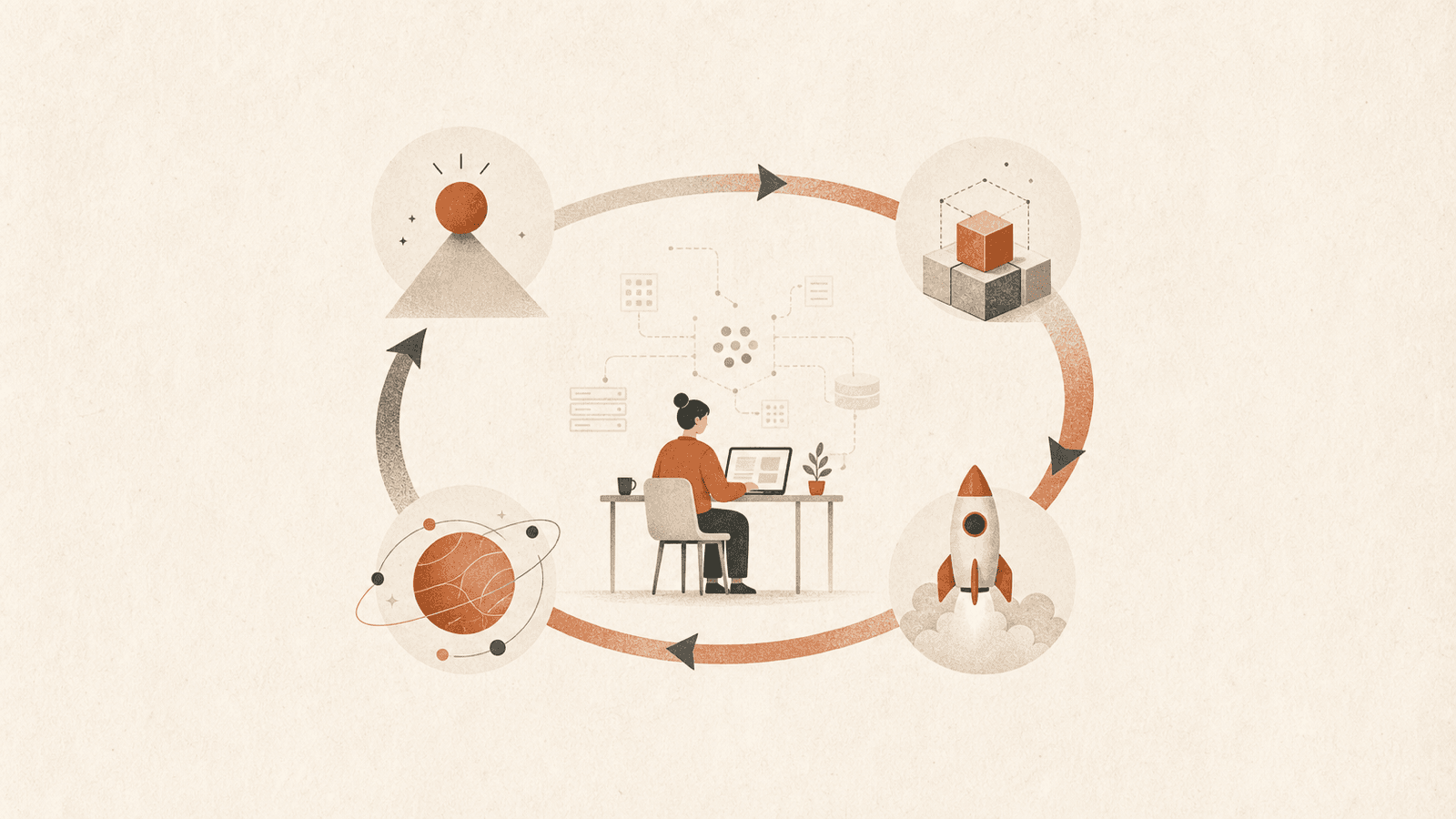
Anthropic's 2026 reframing of the canonical Lean/YC startup arc (validate → raise → hire → build → raise more → grow → hire more) into four stages explicitly assuming AI as core infrastructure: Idea → MVP → Launch → Scale. The structural change is that each new phase no longer requires a bigger team, a different skill set, or a fresh funding round. The "lean 10-person unicorn" is positioned as the deliberate target, not the scrappy outlier. Each stage retains its traditional exit criteria (problem-solution fit → product-market fit → repeatable growth → defensible scale) but the path through compresses quarters into weeks.
Source#
The Founder's Playbook: Building an AI-Native Startup (Anthropic, May 2026). 36-page ebook organized around this four-stage frame; positions Claude (Chat / Cowork / Code) as the infrastructure that makes each stage doable without traditional headcount.
The four stages#
Idea — research-oriented validation#
Goal: assemble qualitative evidence that a real problem exists and that the proposed solution addresses it, before committing build resources.
Exit criteria (all three must be yes):
- The problem is real and specific — you can name who has it, how often, how severely, what they do today.
- Your solution addresses the actual problem (not the one you originally assumed; validation often reshapes it).
- Enough signal to justify building — qualitative evidence that committing to an MVP is a reasoned decision over an act of faith.
Stage hazards (Problem-Solution Fit Discipline):
- Mistaking building for validating (a working prototype is not evidence the problem is real).
- Premature scaling (agentic coding can scale execution far ahead of validated direction).
- Loss of objectivity (AI follows your direction — confirmation bias gets a research engine).
AI's role: research partner. Devil's advocate for the hypothesis. Build TAM/SAM/SOM with pressure-tested assumptions. Competitor-mapping by tier (direct, indirect, potential acquirer, adjacent). Interview-framework audits to surface leading or future-facing questions. Claude Code enters only at the very end for a lightweight prototype to use as a prop in customer conversations — not as the product.
MVP — translate validated problem to working product#
Goal: smallest, most-focused iteration that puts the solution in front of real users and generates evidence of product-market fit. Equally important secondary goal: build without accruing the kind of Agentic Technical Debt that compounds.
Exit criteria: specific identifiable users return to it (retention), pay for it (revenue), or tell others about it (referral). Useful litmus tests:
- Sean Ellis test — >40% of active users say "very disappointed" if they could no longer use it.
- Effort test — retention starts pulling instead of pushing; the heroic founder energy required to keep users engaged drops.
Stage hazards:
- Agentic Technical Debt — compounds, not just accumulates.
- False product-market fit — early traction from founder-friends, investor portfolios, HN spikes doesn't predict week-12 behavior.
- Zero-Friction Scope Creep — when features take an afternoon, the cost-based forcing function disappears.
- Insecure by inexperience — agentic coding produces functional code, not inherently secure code. A security review before any user touches the app is the minimum responsible threshold.
AI's role: Claude Code as primary build tool, but only after architecture and scope are defined as CLAUDE.md context documents. Claude designs the measurement framework before launch. Cowork runs the operational layer (user contact lists, outreach sequences, feedback synthesis).
Launch — turn traction into a sustainable growth engine#
Goal: repeatable, channel-driven growth + production-hardened infrastructure + operational systems that free founder attention. The transition from doing the work to designing the systems that do the work.
Exit criteria (three elements):
- Growth is repeatable and channel-driven (CAC, LTV, payback period are known and defensible).
- Product handles production workloads (security/compliance in order; reliability holds under real conditions).
- Operations run without founder bottlenecks (founder is not personally handling support, triage, sprint planning, or reporting).
Stage hazards:
- Technical debt comes due — MVP shortcuts now accrue interest.
- The founder becomes the bottleneck — decisions that should take an hour take a week; support requests pile up because only the founder knows the answer.
- Security and compliance are no longer deferrable — handling customer data, payments, or regulated industries flips the risk profile.
- Expansion before ready — new markets introduce new variables that collapse the ability to interpret your own data.
AI's role: all three Claude surfaces in full use, compounding. Claude Code audits the MVP codebase for structural weaknesses. Claude triages and sequences remediation. Cowork audits the founder's operational load and categorizes (automate / delegate / founder-only).
Scale — build a defensible business#
Goal: systematic, organizationally-supported growth; build a defensible moat through accumulated depth (see Compounding Data Moat). Founder role re-centers from builder to public-facing executive (analyst briefings, IPO roadshows).
Exit criteria: threshold event, not single milestone. Three typical forms — sustainable profitability that no longer requires external capital, IPO-readiness, or acquisition. All three require systematic auditable growth + product moat under scrutiny + operationally mature organization.
The defining question: "If a well-funded incumbent copied your product today, would your users stay?"
Stage hazards:
- Delegating the operational layer (psychological + structural difficulty trusting AI systems).
- Scaling technical operations (customers want infrastructure-partner reliability, not just product features).
- Scaling organizational functions (hiring, payroll, accounting, legal — regardless of headcount).
- Building a real GTM function (organic founder-led growth hits a ceiling; need marketing, sales, analyst relations).
AI's role: the operational layer of an enterprise-scale organization run by a tiny team. Claude Code hardens code to enterprise standards (logging, monitoring, incident response, observability for enforceable SLAs). Cowork runs enterprise-support operations (ticket routing, escalation, renewal tracking). Claude builds GTM resources from scratch (segmentation, messaging, sales playbooks, analyst-relations strategy).
What's structurally new vs. the canonical lifecycle#
| Traditional lifecycle assumption | AI-native version |
|---|---|
| Each phase needs a bigger team | Headcount can stay flat through Scale |
| Each phase needs a fresh funding round | Capital efficiency makes profitability before Series A plausible |
| Each phase needs a different skill set | Founder + Claude surfaces replace most function-specific hires |
| Validation is gated by "can you build it" | Validation is gated by discipline (the building gate has dropped) |
| Scope creep gated by engineering cost | Scope creep gated by written scope discipline (cost gate has dropped) |
| Technical debt accumulates linearly | Compounds without persistent context files |
| GTM motion needs a team before it scales | Cowork can run enterprise-grade operational layer |
The implicit thesis#
The playbook reads as Anthropic's claim that the founder's job hasn't changed — find a real problem, build something that solves it, scale it — but every stage's bottleneck has moved. The bottleneck is no longer "can you build it" but "do you know what to build, can you stay disciplined while building it, and have you encoded enough domain depth that competitors can't replicate it." See Printing Press Software Democratization for the macro analogy and Founder as Agent Orchestrator for the role implication.
Tensions with other wiki sources#
- vs. AI Employee Framing (HBR Kropp et al., May 2026): the playbook leans hard into "orchestrate agents" / "AI as on-call expert" / "AI as engineering team" / "AI as ops team" framings. HBR's empirical work shows that exactly this kind of anthropomorphizing framing measurably reduces personal accountability (−9pp), increases unnecessary escalation (+44%), and reduces error catching (−18%). The playbook does not engage this evidence. A disciplined founder applying the playbook should retain tool-framed accountability internally even while using the "engineer who's always available, never blocked" mental shortcut.
- vs. Harness Shrinkage as Models Improve: the playbook treats Claude surfaces as fixed infrastructure (Chat / Cowork / Code). But Anthropic's own thesis (Boris Cherny, Cat Wu) is that the harness itself shrinks each release. Founders building permanent workflows around 2026 harness affordances should expect those workflows to need rewriting as capabilities migrate inward.
- vs. Claude Code Best Practices: the playbook recommends starting each Claude Code session with the scope + CLAUDE.md context, ending with a log entry. This is a stricter discipline than the official best-practices doc, framed as the founder-specific safeguard against Agentic Technical Debt.
Connections#
- Founder as Agent Orchestrator — the role shift this lifecycle assumes
- Problem-Solution Fit Discipline — Idea-stage hazards and antidotes
- Agentic Technical Debt — MVP and Launch-stage technical hazard
- Zero-Friction Scope Creep — MVP-stage process hazard
- Compounding Data Moat — Scale-stage defensibility
- Claude Code / Cowork / Anthropic — product surfaces this lifecycle runs on
- Printing Press Software Democratization — macro analogy for the cost-collapse
- Seven Powers Applied to AI — moats that survive the cost-collapse
- Engineer PM Convergence — within-company analogue of the founder-role shift
- AI Employee Framing — counter-evidence on the orchestration framing
- Harness Shrinkage as Models Improve — why the specific Claude affordances will move
- Claude Code Best Practices — the CLAUDE.md discipline this lifecycle requires
- MCP and Computer Use — the integration substrate the playbook prescribes across all four stages (Gmail/Calendar in Idea, feedback loops in MVP, niche-industry-system moats in Scale)
- Evals as Product Spec — "build measurement framework before launch" is the product-level analog of feature-level evals; both are what-does-success-look-like artifacts written before the work
- Campfire / John Glasgow — a real-world instance of the lean AI-native arc (35M Series A at 12 people, doubling ARR/quarter) — and a partial counter-case: founder-led sales, not full delegation
- The AI-Native Safe-Choice Inversion — the demand-side version of the macro shift: buyers' definition of "safe" flips toward AI-native
- Narrow Wedge into a Legacy Market — the Idea/MVP-stage execution discipline (be best for a narrow profile) shown in practice
- Founder-Led Sales Discipline — a Launch/PMF-stage refinement: stay founder-led until PMF (tension with Founder as Agent Orchestrator)
- AI Accelerating AI Development — the supply-side mechanism behind the lean-unicorn demand: each employee "sits atop a pyramid of agents," so a 100-person firm can do 1,000-person work (the essay's diffusion future)
Derived#
- Orchestration vs Employee Framing: Reconciling the Founder's Playbook with HBR's Accountability Evidence — reconciles this lifecycle's orchestration framings with HBR's accountability evidence; operational checklist for the disciplined founder
- How AI-Native Startups Avoid Speed Becoming Strategic Debt — stage-by-stage discipline stack for preventing AI-native speed from becoming strategic debt
Open questions#
- The playbook gives no quantitative evidence for the headcount/capital compression claims (no median time-to-PMF, no headcount-at-PMF numbers, no failure-rate data). The "lean 10-person unicorn" is asserted as deliberate target without case-study evidence in the doc itself.
- Founder stories in the resources section (Carta Healthcare, Anything, Cogent, Airtree, Duvo, Zingage, Kindora, Wordsmith) are short callouts — none have published outcomes or comparable-baseline data.
- The 42% "built-something-nobody-wanted" CB Insights figure is from a pre-AI era; the playbook predicts the rate will climb but doesn't cite a 2026 measurement.
- Tension with HBR's accountability findings (above) is unresolved. The playbook's orchestration framing reads as the exact framing HBR's experimental conditions tested against.
Sources#
- The Founder's Playbook: Building an AI-Native Startup — Anthropic, "The Founder's Playbook: Building an AI-Native Startup," May 2026
Cited by 27
- Agentic Technical Debt
Debt that *compounds* (not just accumulates) because each agentic-coding session re-derives architectural decisions wit…
- AI Accelerating AI Development
The empirical core of *When AI builds itself*: measured evidence AI already speeds AI R&D at Anthropic — >80% of merged…
- AI Employee Framing
Kropp et al. (HBR May 2026, n=1,261): framing AI agents as "employees" vs "tools" cuts personal accountability −9pp, in…
- The AI-Native Safe-Choice Inversion
Buying the legacy incumbent used to be "safe"; post-AI, *being* the incumbent = not AI-native; boards give buyers air c…
- How AI-Native Startups Avoid Speed Becoming Strategic Debt
AI-native startup speed becomes strategic debt unless bounded by validated problem, written scope, persistent architect…
- Anthropic
AI safety company / vendor of Claude; mission-as-tiebreaker culture; ~30–40 PMs across teams; Mike Krieger leads Labs r…
- Campfire
AI-native ERP (YC S23) pulling customers off NetSuite; custom foundation model + agent platform; Series B (Accel/Ribbit…
- Claude Code
Anthropic's agentic coding product; created by Boris Cherny late 2024; TypeScript/React; CLI/desktop/web/mobile/IDE sur…
- Claude Code Best Practices
Anthropic's guide to effective Claude Code usage: context management, verification-driven development, explore→plan→cod…
- Compounding Data Moat
Anthropic's prescription for Scale-stage defensibility: time-locked behavioral fingerprint + domain-encoded edge cases…
- Cowork
Anthropic's non-code knowledge-work agent product; sibling to Claude Code; output is decks/inbox/dossiers; same MCP/com…
- Engineer PM Convergence
Generalists across disciplines; product taste as bottleneck skill; Anthropic Claude Code team as case study; "just do t…
- Evals as Product Spec
Cat Wu's framing of evals as the emerging core PM skill: ten great evals beats a hundred mediocre; encode what done loo…
- Founder as Agent Orchestrator
Founder role shift: less individual contributor, more orchestrator of specialized AI assistants; non-technical founders…
- Founder-Led Sales Discipline
Stay founder-led until PMF; don't offload sales to an AE *or* an agent; explicit tension with Founder As Agent Orchestr…
- Harness Shrinkage as Models Improve
Prompt scaffolding shrinks each model release; Cat Wu's pruning discipline; Boris Cherny "100 lines of code a year from…
- John Glasgow
CEO/founder of Campfire; 10yr corporate finance; founder-led-sales advocate; long-horizon "last job I'll ever have"
- MCP and Computer Use
Anthropic's two complementary connector mechanisms: MCP for structured programmatic access (Salesforce/Drive/Gmail/Slac…
- Startup & Founder
Map of Content for the startup-founder domain — 12 concepts. Curated entry point; see Home for all domains.
- Narrow Wedge into a Legacy Market
Disrupt without being feature-complete: be the best for a narrow customer profile (tech cos outgrowing QuickBooks); Goo…
- Open Questions Backlog
_124 pages with open questions, as of 2026-06-19._
- Orchestration vs Employee Framing: Reconciling the Founder's Playbook with HBR's Accountability Evidence
Reconciles the Founder's Playbook orchestration framings with HBR Kropp et al.'s accountability evidence; "orchestratio…
- Printing Press Software Democratization
Boris Cherny's analogy: 1400s literacy expansion → AI software-writing expansion; domain knowledge displaces coding ski…
- Problem-Solution Fit Discipline
Idea-stage thesis: three defenses against premature building (time, resources, belief friction) all eroded; AI as devil…
- Recursive Self-Improvement
An AI system autonomously designing and developing its own successor; Anthropic Institute's *When AI builds itself* arg…
- Seven Powers Applied to AI
Helmer/Acquired framework re-evaluated for AI: switching costs and process power erode; network effects, scale, cornere…
- Zero-Friction Scope Creep
MVP failure mode when agentic coding removes the cost-based forcing function against scope creep; antidote is written s…
Related articles
- Founder as Agent Orchestrator
Founder role shift: less individual contributor, more orchestrator of specialized AI assistants; non-technical founders…
- Claude Code
Anthropic's agentic coding product; created by Boris Cherny late 2024; TypeScript/React; CLI/desktop/web/mobile/IDE sur…
- Compounding Data Moat
Anthropic's prescription for Scale-stage defensibility: time-locked behavioral fingerprint + domain-encoded edge cases…
- Harness Shrinkage as Models Improve
Prompt scaffolding shrinks each model release; Cat Wu's pruning discipline; Boris Cherny "100 lines of code a year from…
- Open Questions Backlog
_124 pages with open questions, as of 2026-06-19._