Sources#
Summary#
John Glasgow's strongly-held stance that founders should stay in founder-led sales until product-market fit — and explicitly should not offload it, to a hired AE or to an AI agent. He got Campfire to ~$1M ARR as the sole AE running every demo and sale, and still joins as many customer calls as he can and sits "in every Slack channel with every customer." The argument: the founder is the single best person to let customer signal drive engineering, and that loop is too valuable to delegate before PMF.
The stance#
"Even in the AI era, I really recommend founders stay in founder-led sales mode. Offloading it to AI, offloading it to some AE — it feels like 'let's just bring in a professional, whether it's an agent or a person.' But I still recommend being as close to the customer and the prospective customer as possible until you have product-market fit."
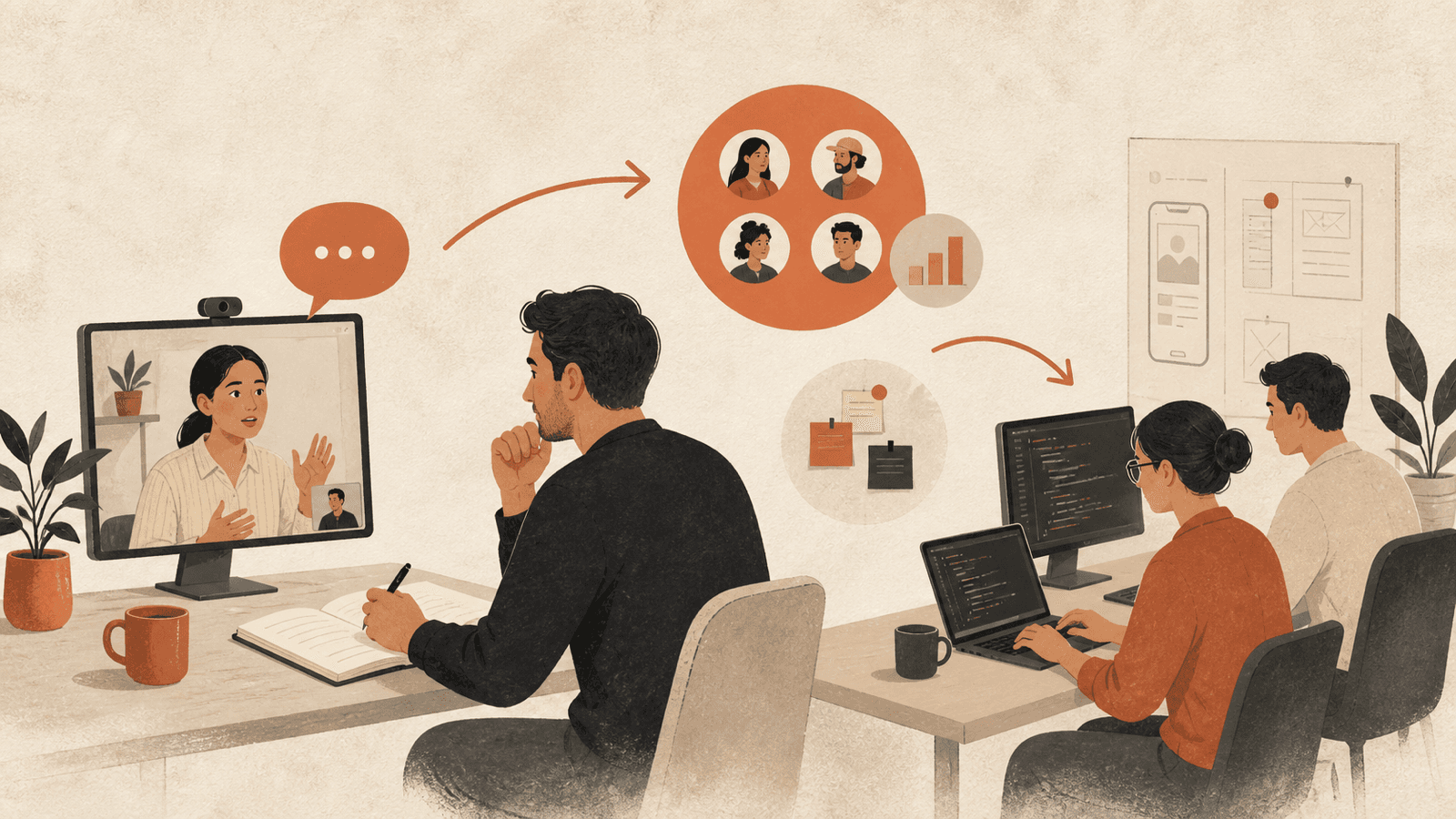
Mechanism he names: "you're the best person in the company to actually impact change on what is happening — the sales team driving engineering." The founder closes the loop between what customers say in the room and what gets built with zero translation loss. He reached the classic ~$1M-ARR Series A bar "on my own as the one AE doing all the demos and sales," and credits it with keeping Campfire from ever pivoting (only "micro-pivoting" on features).
The explicit tension with agent-orchestration#
This is the corpus's sharpest contradiction to flag. Founder as Agent Orchestrator (from the Anthropic Founder's Playbook) argues the founder's role shifts toward orchestrating specialized AI assistants, with non-technical founders unblocked and lean teams enabled — implying you should delegate functions (including, by extension, GTM) to agents. Glasgow says the opposite for sales, pre-PMF: do not hand the customer relationship to an agent (or an AE) yet.
The reconciliation isn't "one is wrong" — it's scope and timing:
- What to orchestrate: Glasgow would happily orchestrate agents for building (Campfire is itself AI-native, ships daily — Product Velocity as Moat). The thing he won't delegate is the founder's direct customer-signal loop before PMF.
- Founder-led sales is itself a form of Dogfooding as Product Discipline — dogfooding the demand side. It's not anti-AI; it's protecting the highest-signal human input while everything mechanical gets automated.
- This mirrors Outsource Your Thinking, Not Your Understanding: outsource the thinking/execution, but the founder's understanding of the customer is the non-delegable residue.
So the playbook's "orchestrate agents" and Glasgow's "don't offload sales" are compatible if you read orchestration as workflow design over mechanical work rather than delegation of the founder's core judgment — exactly the distinction drawn in Orchestration vs Employee Framing: Reconciling the Founder's Playbook with HBR's Accountability Evidence.
Why pre-PMF specifically#
The discipline is time-boxed to "until product-market fit." Before PMF, the signal-to-build loop is the company's search process; after PMF, the motion is more known and can be staffed. Glasgow pairs it with the other YC final-day advice he follows religiously — build in the Bay, build in person, get to Series A — all of which are about maximizing high-bandwidth signal during the search phase.
Connections#
- John Glasgow / Campfire — the source and exemplar
- Founder as Agent Orchestrator — the explicit counterpoint; reconciled by scope (mechanical work) vs. founder's core customer judgment
- Orchestration vs Employee Framing: Reconciling the Founder's Playbook with HBR's Accountability Evidence — the framework that resolves the tension: orchestration-as-workflow-design survives; delegating core judgment doesn't
- Dogfooding as Product Discipline — founder-led sales is dogfooding the demand side; "in every Slack channel" is the same instinct
- Outsource Your Thinking, Not Your Understanding — outsource execution, not the founder's understanding of the customer
- Problem-Solution Fit Discipline — staying close to the customer is how you actually find problem-solution fit vs. confirmation-bias building
- AI-Native Startup Lifecycle — situates the stance within the Idea→MVP→Launch→Scale arc (it's a Launch/PMF-stage rule)
Open Questions#
- Where exactly does "until PMF" end, and what's the first thing a founder should hand off (AE? agent? both)? Glasgow still does it post-Series-B, suggesting the boundary is fuzzy.
- Does Glasgow's anti-offload stance generalize, or is it specific to high-trust, mission-critical enterprise sales (ERP) where "they're buying you" — would a PLG/SMB motion delegate to agents far earlier?
Sources#
Cited by 11
- AI-Native Startup Lifecycle
Anthropic's May 2026 reframing of Idea/MVP/Launch/Scale assuming AI infrastructure: each stage's headcount/capital/skil…
- How AI-Native Startups Avoid Speed Becoming Strategic Debt
AI-native startup speed becomes strategic debt unless bounded by validated problem, written scope, persistent architect…
- Campfire
AI-native ERP (YC S23) pulling customers off NetSuite; custom foundation model + agent platform; Series B (Accel/Ribbit…
- Dogfooding as Product Discipline
Product sense is built by relentless first-hand use ("ant food"); Mr. Peanut catch; cross-source (Cat Wu vibe-checks, G…
- Founder as Agent Orchestrator
Founder role shift: less individual contributor, more orchestrator of specialized AI assistants; non-technical founders…
- John Glasgow
CEO/founder of Campfire; 10yr corporate finance; founder-led-sales advocate; long-horizon "last job I'll ever have"
- Startup & Founder
Map of Content for the startup-founder domain — 12 concepts. Curated entry point; see Home for all domains.
- Open Questions Backlog
_124 pages with open questions, as of 2026-06-19._
- Outsource Your Thinking, Not Your Understanding
"You can outsource your thinking but not your understanding"; understanding as the non-delegable human bottleneck; know…
- Problem-Solution Fit Discipline
Idea-stage thesis: three defenses against premature building (time, resources, belief friction) all eroded; AI as devil…
- Product Velocity as Moat
Shipping speed as differentiator + trust signal ("you'll scale with us"); a treadmill that must convert into durable lo…
Related articles
- Narrow Wedge into a Legacy Market
Disrupt without being feature-complete: be the best for a narrow customer profile (tech cos outgrowing QuickBooks); Goo…
- AI-Native Startup Lifecycle
Anthropic's May 2026 reframing of Idea/MVP/Launch/Scale assuming AI infrastructure: each stage's headcount/capital/skil…
- Compounding Data Moat
Anthropic's prescription for Scale-stage defensibility: time-locked behavioral fingerprint + domain-encoded edge cases…
- John Glasgow
CEO/founder of Campfire; 10yr corporate finance; founder-led-sales advocate; long-horizon "last job I'll ever have"
- Agentic Technical Debt
Debt that *compounds* (not just accumulates) because each agentic-coding session re-derives architectural decisions wit…