Sources#
Summary#
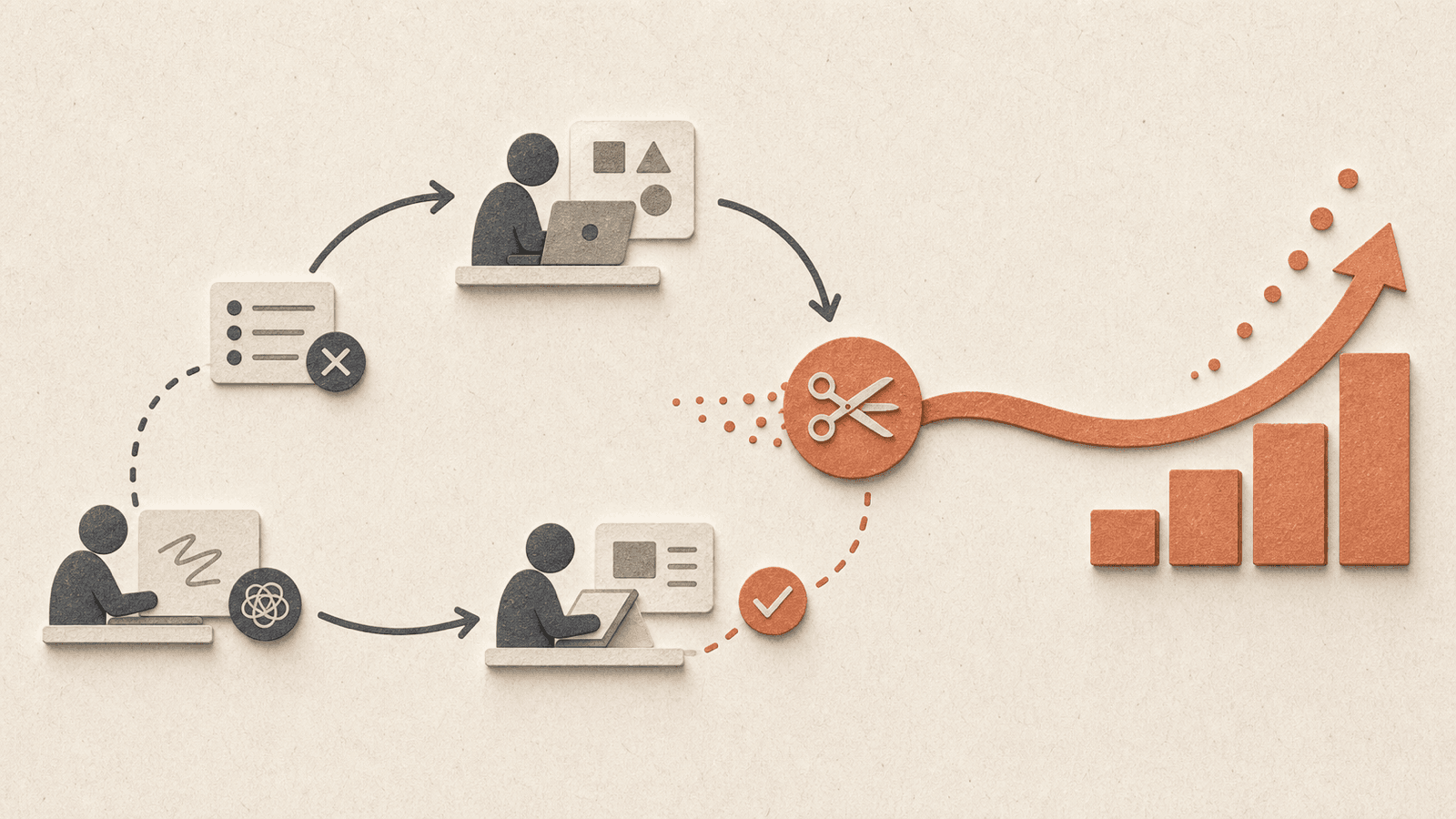
Dan Carey's account of the operational engine behind Claude Design: a basic build loop — talk to users → design features → ship code → read feedback → repeat — run "somewhere between 50 and 100 times over the course of ten weeks," with every recurring step inside it aggressively optimized or automated. The governing question the team asks of each step is: "Why are you doing this work that Claude could do for you? Why haven't you built your own tooling?" The payoff is multiplicative: any friction you remove from the loop is removed 50–100 times, so cheap internal tooling — much of it built in an afternoon — compounds into the velocity that lets three people ship a product in ten weeks. Carey is explicit that the specific loop doesn't matter ("if you're working on hardware, this is the wrong loop"); the transferable thing is the thought process of treating your own iteration loop as the object to be optimized.
Why optimization compounds#
Removing planning drag (prototypes over PRDs, Prototype Over PRD) and coordination drag (tiny teams, Engineer PM Convergence) gets you "pretty fast." The extra gear is optimizing every other step:
"Every little bit of optimization that you do on your loop is going to pay you back if you're running it 50 to 100 times in a project."
This is the lean-startup loop with the AI-native twist that the cost of building the tooling that optimizes the loop has collapsed. The forcing function is no longer "can we afford to build this internal tool?" but "why haven't we already?"
The four steps, each instrumented#
Talk to users — make it the easiest thing in the world#
"We are people. We do things that are easy." So the team removes every gram of friction from talking to users: shared Slack channels with everyone using the product, heavy internal dogfooding. Then it adds Claude as an analysis layer behind (never between) the conversations: Claude reads every customer conversation and surfaces commonalities across them — because two teammates may hear the same suggestion from different users and would otherwise never connect them. "We are the ones having the conversation… but we have it do all of the analysis."
Design features — use your own tool#
Self-hosting: "we wanted to use Claude Design to design Claude Design." The dogfooding case in its purest form (see Dogfooding as Product Discipline). Features like multiplayer (real-time co-editing) emerged directly from watching their own workflow friction, then became the product's first user-requested feature.
Ship code — remove the handoff friction#
The handoff to Claude Code feature exists because the team kept re-typing, across tools, all the context they'd built up over a long Claude Design conversation just to get a design into production. They automated their own friction; it became users' second-most-requested feature ("now how do I get this into production?").
Read feedback — build the tool you're waiting for#
At launch the team got more feedback than any one person could read. So they built a feedback-clustering tool in an afternoon ("it wasn't something we were going to wait on"). Claude now does the first pass on all incoming feedback: matches it to system monitors and traces, looks for trends, runs initial bug analysis, suggests a fix, and exposes a button to push it straight into dev tooling — each addition a step the humans were previously doing by hand.
"Just build it" — internal tooling on demand#
Carey's second "try tomorrow" action is the page's thesis as a directive:
"Pick something that you've been waiting for… and just build it one afternoon. Everyone waits on tools when at this point internal tooling… is rapid. Go ahead and scratch your own itch. It will pay itself off very quickly."
This is the same economics Problem-Solution Fit Discipline notes ("prototype in an afternoon") turned toward internal tools, and it is why Cat Wu reports Anthropic teams building "custom internal apps for personalized workflows."
Tight loops also catch wrong bets fast#
The other half of running the loop many times: you find out you're wrong quickly. The team shipped advanced pixel-level controls that vocal power users loved — then discovered "everybody else hated them," and ripped them out. Total elapsed time: one week. "If we had been doing a quarterly development cycle… we would have been off track for an entire quarter." The lesson Carey draws is not "always go fast" but "always iterate in a small enough cycle that you can quickly find out when you're wrong" — the run-experiments discipline applied post-launch, and the product-craft conclusion that a tool should lift the floor for everyone, not just raise the ceiling for power users (see Claude Design).
Connections#
- Dan Carey — articulates the discipline
- Claude Design — the product built this way; many of its features are crystallized loop-optimizations
- Prototype Over PRD — the planning-step optimization; this page is the same instinct applied to every other step
- AI Native Product Cadence — the team-and-process cadence this loop runs inside; Carey is a second Anthropic data point for it
- Dogfooding as Product Discipline — "talk to users, make it the easiest thing" and "use your own tool" are dogfooding; Claude-assisted conversation analysis is its scaled form
- Product Velocity as Moat — the external payoff of a relentlessly optimized loop: 62 improvements shipped Friday→Monday; velocity as differentiator
- Problem-Solution Fit Discipline — tight loops let you discover a wrong bet (the power-user controls) in a week, not a quarter
- Build for the Next Model — the other reason to keep the loop running: the next model release closes gaps your engineering can't
- Managers as ICs — building your own tooling presumes everyone can code; the flat IC-heavy org is the substrate
- Harness Shrinkage as Models Improve — the loop's internal tooling shrinks/changes as the model absorbs more of each step natively
Open Questions#
- The loop assumes the team is (close to) the user. How much of the compounding advantage survives when the user is unlike the builder and "talk to users" can't be same-room?
- Where is the line between worthwhile internal tooling and yak-shaving? Carey's "afternoon" bar is the heuristic, but Cat Wu warns that over-customizing setups "becomes distraction."
- Does Claude-as-first-pass-on-all-feedback ever filter out the rare signal that doesn't cluster? Automating triage optimizes the common case; the tail is where surprising bets come from.
Sources#
Cited by 13
- AI Native Product Cadence
Cat Wu's 6mo→1mo→1day cadence at Anthropic: research-preview branding, mission-as-tiebreaker, evergreen launch room, li…
- Anthropic Labs
Anthropic's internal incubator — a 'bet factory' of ~a dozen tiny teams exploring the model frontier with lean-startup…
- Build for the Next Model
Prototype the thing that almost works, not the thing that already works: bet that the next concrete model release (not…
- Claude Design
Anthropic Labs product (research preview, ~April 2026) for collaborating with Claude on polished visual artifacts — des…
- Dan Carey
Product Manager leading product within Anthropic Labs; led Claude Design; 'Designing with Claude' talk (May 2026); ~two…
- Dogfooding as Product Discipline
Product sense is built by relentless first-hand use ("ant food"); Mr. Peanut catch; cross-source (Cat Wu vibe-checks, G…
- Engineer PM Convergence
Generalists across disciplines; product taste as bottleneck skill; Anthropic Claude Code team as case study; "just do t…
- Managers as ICs
Every Claude Code manager starts as an IC; flat org; agentic coding collapsed the onboarding cost that pushed managers…
- Product & Organization
Map of Content for the product-org domain — 8 concepts. Curated entry point; see Home for all domains.
- Open Questions Backlog
_96 pages with open questions, as of 2026-06-14._
- Problem-Solution Fit Discipline
Idea-stage thesis: three defenses against premature building (time, resources, belief friction) all eroded; AI as devil…
- Product Velocity as Moat
Shipping speed as differentiator + trust signal ("you'll scale with us"); a treadmill that must convert into durable lo…
- Prototype Over PRD
Dan Carey's prototype-replaces-PRD method: record a why-not-what conversation, transcribe it, hand the transcript to Cl…
Related articles
- AI Native Product Cadence
Cat Wu's 6mo→1mo→1day cadence at Anthropic: research-preview branding, mission-as-tiebreaker, evergreen launch room, li…
- Claude Design
Anthropic Labs product (research preview, ~April 2026) for collaborating with Claude on polished visual artifacts — des…
- Anthropic Labs
Anthropic's internal incubator — a 'bet factory' of ~a dozen tiny teams exploring the model frontier with lean-startup…
- Build for the Next Model
Prototype the thing that almost works, not the thing that already works: bet that the next concrete model release (not…
- Claude Code
Anthropic's agentic coding product; created by Boris Cherny late 2024; TypeScript/React; CLI/desktop/web/mobile/IDE sur…