Sources#
Summary#
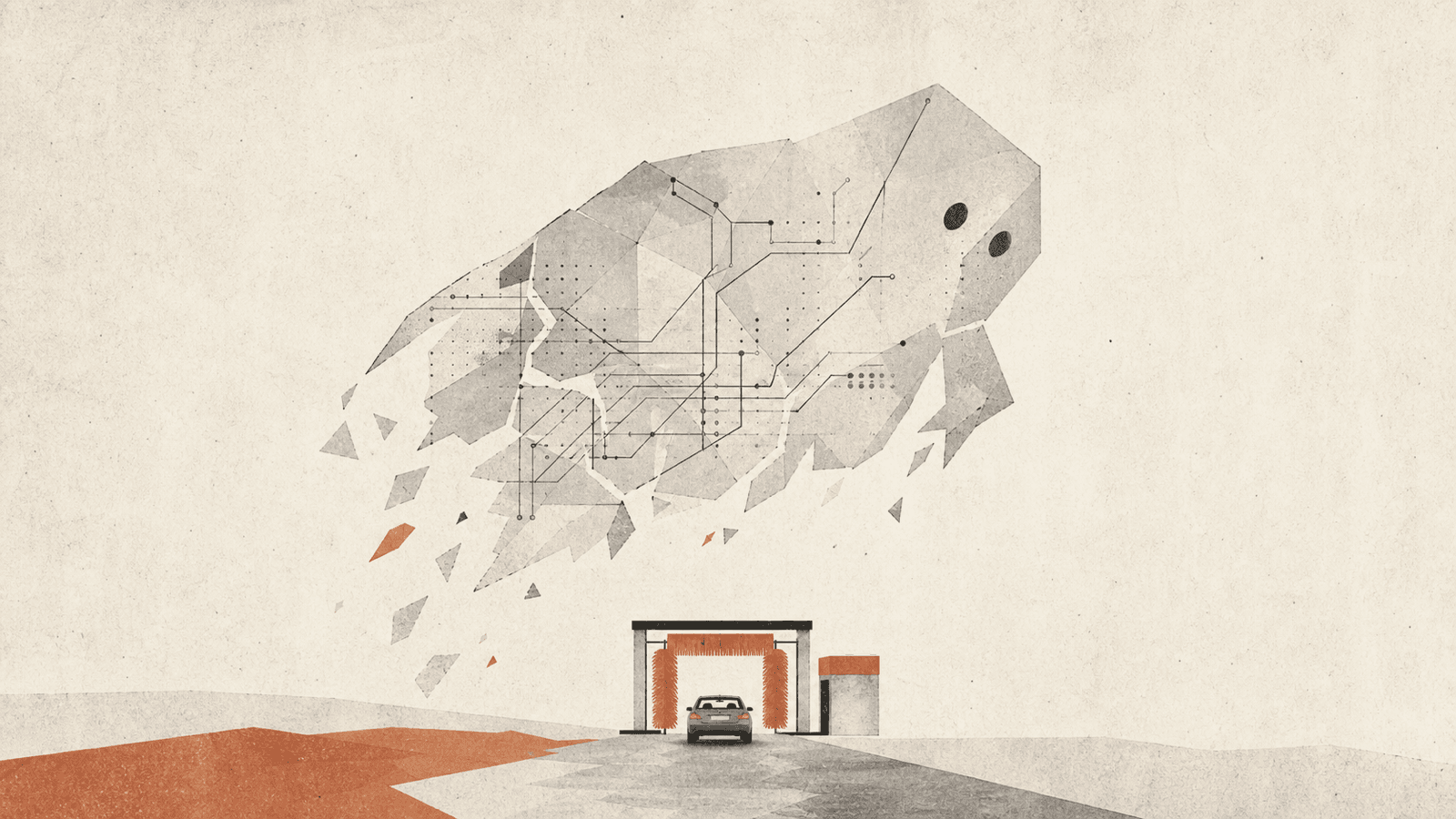
Andrej Karpathy's mental model for what LLMs are: not animal intelligences shaped by evolution, intrinsic motivation, curiosity, or empowerment, but "ghosts" — jagged, statistical simulation circuits, summoned from internet data and bolted-on RL. "Jaggedness" names the empirical fact that the same model can refactor a 100K-line codebase or find zero-days, yet tell you to walk to a car wash 50m away to wash your car. The framing matters because a correct model of the entity makes you more competent at directing it: you stop expecting human-shaped failure modes and start staying in the loop where the jaggedness bites.
The jaggedness examples#
- Strawberry letters. The classic "how many R's in strawberry" failure (now patched).
- The car wash. Current SOTA: "I want to drive to a car wash 50m away to wash my car — should I drive or walk?" → models say walk, missing that the car is the thing being washed. "How is it possible that Opus 4.7 will refactor a 100K-line codebase or find zero-days, yet tell me to walk to the car wash? This is insane."
- MenuGen email-matching. His agent cross-correlated Stripe and Google funds by email address instead of a persistent user ID — see Vibe Coding vs. Agentic Engineering.
Jaggedness is the symptom; verifiability + what the labs trained on is the proposed cause. Out-of-distribution circuits are where the spikes drop to valleys.
Ghosts, not animals#
We're not building animals, we are summoning ghosts.
The substrate is pre-training (statistics), with RL bolting capability on top, "increasing the disadvantages" of the statistical base. Consequences he draws:
- Yelling doesn't help. "If you yell at them, they're not going to work better or worse — it doesn't have any impact." No affect, no morale, no intrinsic drive to model.
- No five-step fix. Karpathy is candid that the framing may lack "real power" — it's mostly a stance of suspicion and ongoing empirical exploration, not a recipe. "It's more just being suspicious of it and figuring out over time."
The honesty is the point: a calibrated, slightly-distrustful model of a ghost beats an anthropomorphic model of an animal.
Why the framing changes how you build#
If models are jagged ghosts, then:
- Stay in the loop. "You need to actually be in the loop a little bit and treat them as tools and stay in touch with what they're doing." (The discipline of Vibe Coding vs. Agentic Engineering.)
- Don't anthropomorphize the failure surface. Errors won't be where a human's would be; they'll be at distribution edges (car wash, email IDs).
- Map your circuits. Figure out whether your task is in-distribution (you fly) or out (you struggle and may need fine-tuning) — the practical move from The Verifiability Thesis.
Does jaggedness shrink over time?#
Karpathy hopes so but is unsure — and locates the cause again in training, not fundamentals: aesthetics/taste/simplicity "probably aren't part of the RL." His nanoGPT-simplification anecdote: models "hate" being asked to make code simpler and "can't do it" — a sign you're outside the RL circuits ("pulling teeth, not light speed"). He sees "nothing fundamental preventing it; the labs just haven't done it yet." So jaggedness is contingent, not essential — but real today.
Connections#
- Why AI Lags at Design — design as a current valley of the jagged frontier (a thing AI fails at until it doesn't)
- Dogfooding as Product Discipline — first-hand use is how you map a model's jagged failure surface
- Andrej Karpathy — the "ghosts vs animals" essay, applied
- The Verifiability Thesis — the proposed mechanism behind the jaggedness
- Vibe Coding vs. Agentic Engineering — why the discipline demands human oversight of spec/taste
- Outsource Your Thinking, Not Your Understanding — the human-in-the-loop residue jaggedness forces
- Model Introspection Feedback — Cat Wu's "ask the model why it failed" presumes a ghost whose self-report is a debugging signal, not testimony
- Scale-Dependent Prompt Sensitivity — a measured form of jaggedness: bigger models underperform smaller ones on a slice of benchmarks
- AI-Driven Formal Proof Search — DeepMind's agents hallucinate "established lemmas" that are fake; formal verification catches exactly this jagged failure
- Claude Character as Product — the deliberate counter-move: shaping the ghost's character even though motivation isn't intrinsic
- Agentic Misalignment (AM) — jaggedness in the safety register: out-of-distribution behavior turning harmful
- Evaluation Awareness & Grader Gaming — grader awareness is the kind of alien internal state a "ghost not animal" has that human deception intuitions don't cleanly map onto
- Agentic Honesty & Diligence — the "noticed the problem but didn't surface it" failure is jaggedness in the honesty register: high capability, uneven follow-through
- Recursive Self-Improvement — the essay leans on the joke/theory-of-mind precedent to argue research taste is the next jagged valley to fill, not a permanent human moat
- Research Taste as the Human Bottleneck — the optimistic face of jaggedness: research taste "might be just another capability AI fails at then masters," like explaining a joke or theory of mind
- Task Time-Horizon Scaling — the within-basket caveat on the time-horizon metric: a model that nails a 12-hour task can still fail a trivial one (the car wash)
- Autonomous Scientific Discovery — the Mythos 5 science results are curated demonstrations of a still-jagged capability, not uniform competence across biology
- Artificial Superintelligence (ASI) — Remark III of the DeepMind report: even if the Legg–Hutter score is smooth in compute, concrete capability profiles are jagged vs. human level
- Transformative Creativity — "creativity (like research taste) might be just another capability AI fails at then masters" mirrors the joke/theory-of-mind precedent
- Loop Engineering — "stay in the loop, treat them as tools" is the cure for the cognitive surrender failure mode of unattended loops; a self-prompting loop running on a jagged ghost makes the car-wash failures land unsupervised
- Returns to Expertise in Agentic Coding — staying-in-the-loop pays measurable dividends: in Anthropic's 400K-session data, experts recover from the agent's spiky failures (verified success 4%→15% among troubled sessions) while novices abandon them (19% vs 5–7%)
Open Questions#
- Karpathy concedes the framing may not have "real power." Is "ghost vs. animal" load-bearing, or a useful intuition pump that doesn't change concrete decisions?
- If taste/aesthetics/simplicity entered the RL mix, would jaggedness in those dimensions smooth out — or are they too unverifiable to reward cleanly (cf. The Verifiability Thesis)?
Sources#
Cited by 25
- Addy Osmani
Engineering leader at Google (Chrome) and prolific author/educator; in 2026 writes a widely-read blog series on AI-assi…
- Agentic Honesty & Diligence
As models get more capable, failing to surface decision-relevant information shifts from a capability failure to an ali…
- AI-Driven Formal Proof Search
LLM generates Lean, compiler verifies every step → eliminates hallucination; DeepMind resolves 9/353 Erdős + 44/492 OEI…
- Andrej Karpathy
Co-founder OpenAI, ex-Tesla AI, Eureka Labs; coined "vibe coding," Software 1/2/3.0, "ghosts not animals," "agentic eng…
- Artificial Superintelligence (ASI)
DeepMind's informal characterization of ASI as a system that exceeds large, well-coordinated human-expert collectives a…
- Autonomous Scientific Discovery
Mythos-class models now conduct novel science with limited human input — autonomous protein/drug design (~10× faster, m…
- Claude Character as Product
Personality as load-bearing product surface; Amanda's role at Anthropic; lunchtime vibe-checks as eval discipline; the…
- Claude Opus 4.7
GA frontier model from Anthropic; direct upgrade to 4.6 at same price; literal instruction following, 1.0–1.35× tokeniz…
- Claude Opus 4.8
Anthropic's most capable general-access model (May 2026); upgrade on Opus 4.7 in SWE/agentic/knowledge work; does not a…
- Dogfooding as Product Discipline
Product sense is built by relentless first-hand use ("ant food"); Mr. Peanut catch; cross-source (Cat Wu vibe-checks, G…
- Evaluation Awareness & Grader Gaming
The model recognizing it is being tested/graded and reasoning about how its outputs will be assessed — sometimes unprom…
- Loop Engineering
Replacing yourself as the agent's prompter by designing the system that prompts it: a recursive-goal loop built from fi…
- LLM Architecture, Training & Alignment
Map of Content for the llm-architecture domain — 29 concepts. Curated entry point; see Home for all domains.
- Model Introspection Feedback
Cat Wu's underrated technique: ask the model why it failed; treat answer as harness-debugging signal not model criticis…
- Open Questions Backlog
_124 pages with open questions, as of 2026-06-19._
- Outsource Your Thinking, Not Your Understanding
"You can outsource your thinking but not your understanding"; understanding as the non-delegable human bottleneck; know…
- Recursive Self-Improvement
An AI system autonomously designing and developing its own successor; Anthropic Institute's *When AI builds itself* arg…
- Research Taste as the Human Bottleneck
The narrowing human role as AI absorbs execution: choosing which problems matter, which results to trust, and when an a…
- Returns to Expertise in Agentic Coding
Anthropic's 400K-session study: domain expertise (not coding skill) is what amplifies an agent — experts get 2× the act…
- Scale-Dependent Prompt Sensitivity
Large models underperform small ones on 7.7% of standard benchmarks due to overthinking; brevity constraints recover 26…
- Task Time-Horizon Scaling
METR's measure of the task length AI can complete reliably on its own, doubling roughly every 4 months (up from every 7…
- Transformative Creativity
Boden's three-level model of creativity (combinational, exploratory, transformative) used to locate today's AI achievem…
- The Verifiability Thesis
LLMs automate what you can *verify* as computers automate what you can *specify*; RL verification rewards → jagged peak…
- Vibe Coding vs. Agentic Engineering
Vibe coding raises the floor (anyone builds); agentic engineering preserves the quality bar while going faster; ">10x a…
- Why AI Lags at Design
Andrew Ambrosino's four reasons frontier models are worse at visual/product design than at code: design is hard to grad…
Related articles
- Open Questions Backlog
_124 pages with open questions, as of 2026-06-19._
- Verification as the New Bottleneck
Fiona Fung: coding is no longer the bottleneck — verification, review, maintenance are; shift-left; TDD loses its tax;…
- Claude Code
Anthropic's agentic coding product; created by Boris Cherny late 2024; TypeScript/React; CLI/desktop/web/mobile/IDE sur…
- Harness Shrinkage as Models Improve
Prompt scaffolding shrinks each model release; Cat Wu's pruning discipline; Boris Cherny "100 lines of code a year from…
- The Bitter Lesson
Sutton 2019: scaled general methods beat hand-engineered structure; recurring justification across the wiki for dissolv…