Sources#
Summary#
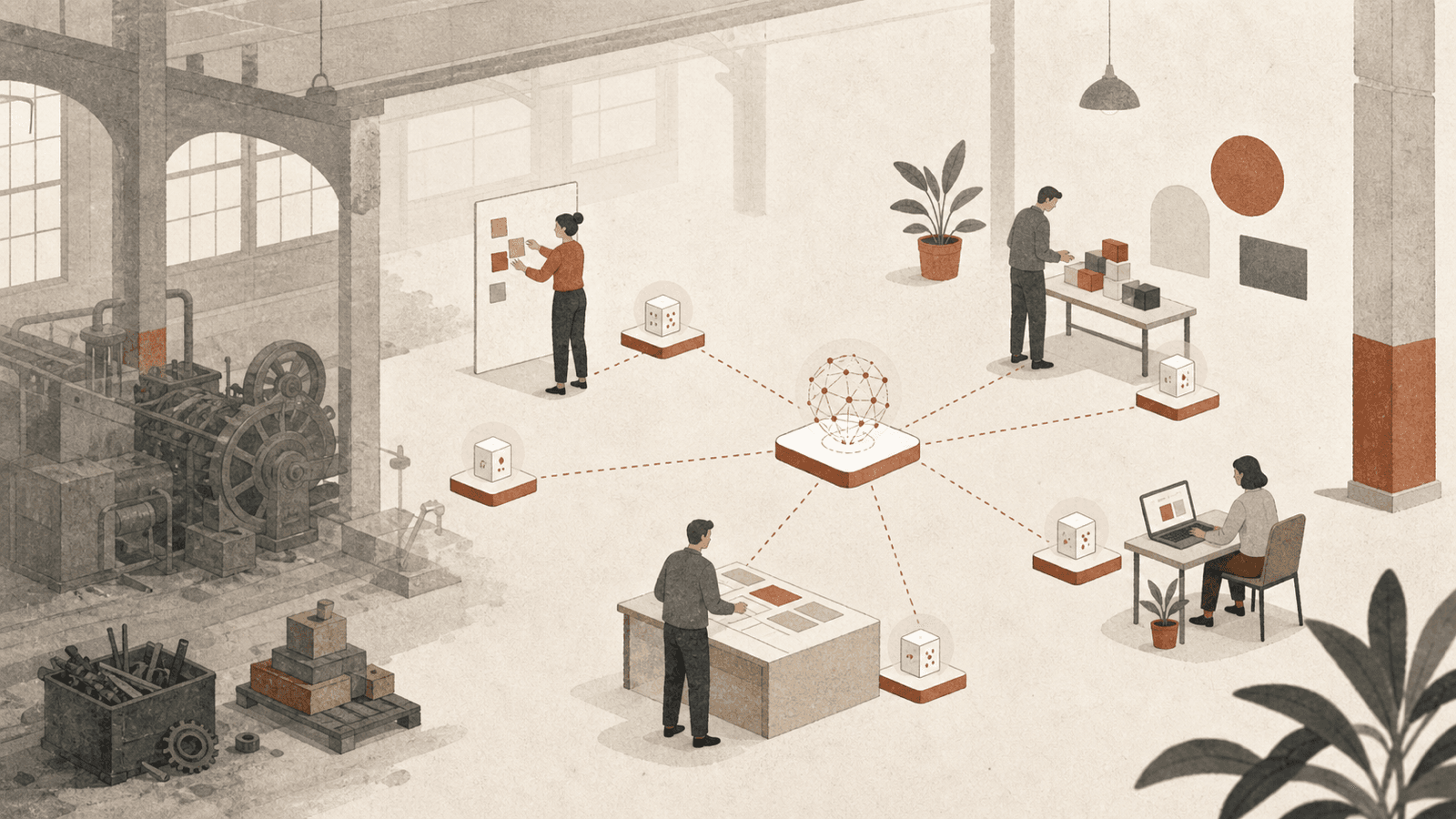
The economics frame OpenAI's Codex usage study uses to explain why agentic-AI adoption is so uneven across populations under an identical model: a long tradition of general-purpose-technology research holds that productivity gains from a new technology depend on complementary investments — in business processes, worker skills, organizational design, and intangible capital — not on the technology's capability alone. The canonical case is David (1990)'s dynamo: early factories swapped centralized steam engines for centralized electric motors while keeping the old plant layout, and got little. The large gains came only decades later, when firms redesigned production around electricity's distinctive affordance (small, decentralized motors → reorganized factory floors, new task sequencing, flexible layouts). The history's lesson, applied to agentic AI: near-term effects may understate long-run potential, because firms have not yet discovered or scaled the new production processes the technology makes feasible — Brynjolfsson's "modern productivity paradox" restated for AI.
Evidence note.
empiricalfor the Codex cross-population data; the GPT/complements framing is the paper's synthesis of prior economics literature (David 1990; Brynjolfsson, Rock & Syverson 2019; Demirer et al. 2026). It is an interpretation of the adoption gaps, not a measured causal estimate of complements.
The three-population gap as a natural experiment#
The paper's sharpest empirical move: if adoption depended only on model capability, usage would look similar wherever the same model is available. It does not. Codex's output-token share is 99.8% (OpenAI) / 63.3% (organizational) / 16.5% (individual) — and OpenAI workers use it across far more job functions and at far higher concurrency. Since the model is constant, the gap must be complements:
- Access to relevant files, repositories, and systems
- Permissions and security requirements
- Workforce skills and familiarity with frontier models
- Management expectations and organizational buy-in
- Complementary review processes for verifying delegated work
OpenAI is the high-complement extreme (cheap marginal usage, training campaigns, feedback loops, model-adjacent workflows), which is exactly why its usage is a frontier preview rather than a population estimate. The conclusion: agentic AI is not simply a cheaper input into existing work — its value depends on whether organizations can redesign workflows, responsibilities, and review processes around delegation and verification.
Why this transition may be faster than electrification#
The paper flags one disanalogy that cuts the other way. Electrification required firms to redesign physical plants and replace durable capital — slow and expensive. Agentic AI lets workers and organizations experiment with new workflows at low cost: no factory to rebuild, just process and tooling to rearrange. This lower cost of experimentation may let new production methods diffuse faster than in prior GPT transitions — even though the full organizational complements are still emerging. The within-OpenAI evidence supports speed: between Dec 2025 and April 2026, later-adopting functions (legal, recruiting) went from ~0 to ~75% Codex token share, with the steepest stretch ~20%→75% in a single month, riding an internal adoption campaign.
The complement that binds: verification and coordination#
Across the literature the paper cites, the recurring complement is supervision/verification/coordination capacity. Hitzig et al. (2026) (which this paper cites) argues agentic systems move interaction from assistance toward delegation, "making supervision, verification, and coordination central determinants of value creation while increasing returns to domain expertise." Demirer et al. (2026b) show large task-level gains translate only imperfectly into output because downstream human activities remain bottlenecks; Demirer et al. (2026a) find AI helps most when it can execute contiguous chains of tasks (workflow adjacency matters). The through-line: the missing complement is usually not a better model but a redesigned review-and-coordination process around the delegated work — the org-level form of Verification as the New Bottleneck.
Connections#
- Conversation-to-Delegation Shift — the three-population usage gap this page explains; same model, different complements → 99.8% vs 63.3% vs 16.5%
- Acceleration Whiplash — the downstream-cost evidence of missing complements: when orgs adopt AI faster than they redesign review/QA, throughput rises but quality and incidents degrade — the productivity-paradox failure mode in telemetry
- Returns to Expertise in Agentic Coding — the cited Hitzig et al. argument that supervision/verification/coordination and domain expertise are the binding complements; the returns-to-expertise data is the worker-level version
- Exposure Taxonomy: Observed, Theoretical, Reported, Anticipated — the GDP gradient in reported AI exposure is this page's argument in survey form: lower-income workers may lack the complementary skills/infrastructure (the IMF point) that turn exposure into augmentation rather than replacement
- The Automation–Optimism Link — optimism and perceived skill-value concentrate among heavy delegators, consistent with complements gating who captures AI's gains
- Verification as the New Bottleneck — the specific complement that most often binds: review/verification capacity is the redesign agentic AI demands
- Engineer PM Convergence — the role-redesign complement: jobs shift toward directing, monitoring, and integrating agent output rather than executing tasks
- Human-AI Accountability Redesign — the accountability/span-of-control complement that has to be rebuilt for delegated agent labor
- AI Native Product Cadence — the startup-side version: AI-native orgs are born with the complements (workflow, review, tooling) rather than retrofitting them
- Compounding Data Moat — encoded org-specific context (the systematization complement) is itself an intangible-capital complement in the Brynjolfsson sense
- Printing Press Software Democratization — capability democratizes broadly, but realized value still concentrates where complements exist; the two together explain the uneven diffusion
- OpenAI — the lab whose high-complement internal environment is the upper bound of this argument
Open questions#
- The "digital production diffuses faster than electrification" claim is asserted from one favorable internal case. Do external organizations actually redesign workflows quickly, or does the low cost of tool adoption mask slow, expensive process redesign (the real complement)?
- Which complement is the true binding constraint — access/permissions, skills, or review capacity? The paper lists all; it doesn't decompose their relative weight.
- If complements, not capability, gate value, does model progress have diminishing near-term returns until orgs catch up — and how long is that lag for agentic AI specifically?
Sources#
- The Shift to Agentic AI: Evidence from Codex — §2 Related literature (organizational complements; David 1990; Brynjolfsson et al. 2019; Hitzig et al. 2026; Demirer et al. 2026a/b); §5 intro (electrification analogy); §6 Conclusion
Cited by 11
- Acceleration Whiplash
Faros 2026: AI floods a human-paced SDLC with output it can't absorb — throughput up (tasks +34%, epics +66%), quality…
- AI Native Product Cadence
Cat Wu's 6mo→1mo→1day cadence at Anthropic: research-preview branding, mission-as-tiebreaker, evergreen launch room, li…
- The Automation–Optimism Link
AEI Cadences survey finding: people who use Claude in more automated ways are MORE optimistic across all six job-qualit…
- Compounding Data Moat
Anthropic's prescription for Scale-stage defensibility: time-locked behavioral fingerprint + domain-encoded edge cases…
- Conversation-to-Delegation Shift
OpenAI's Codex usage study (June 2026): the move from conversational AI ('asking') to agentic AI ('delegated production…
- Engineer PM Convergence
Generalists across disciplines; product taste as bottleneck skill; Anthropic Claude Code team as case study; "just do t…
- Exposure Taxonomy: Observed, Theoretical, Reported, Anticipated
Four distinct ways to measure AI's reach into an occupation — observed exposure (tasks seen done with Claude), theoreti…
- Human-AI Accountability Redesign
HBR five-pillar prescription: span-of-control redesign, role redesign, performance management reset, decision-rights/es…
- Governance & Workforce
Map of Content for the governance-workforce domain — 16 concepts. Curated entry point; see Home for all domains.
- Printing Press Software Democratization
Boris Cherny's analogy: 1400s literacy expansion → AI software-writing expansion; domain knowledge displaces coding ski…
- Returns to Expertise in Agentic Coding
Anthropic's 400K-session study: domain expertise (not coding skill) is what amplifies an agent — experts get 2× the act…
Related articles
- AI Employee Framing
Kropp et al. (HBR May 2026, n=1,261): framing AI agents as "employees" vs "tools" cuts personal accountability −9pp, in…
- Returns to Expertise in Agentic Coding
Anthropic's 400K-session study: domain expertise (not coding skill) is what amplifies an agent — experts get 2× the act…
- Conversation-to-Delegation Shift
OpenAI's Codex usage study (June 2026): the move from conversational AI ('asking') to agentic AI ('delegated production…
- Harness Shrinkage as Models Improve
Prompt scaffolding shrinks each model release; Cat Wu's pruning discipline; Boris Cherny "100 lines of code a year from…
- Claude Code
Anthropic's agentic coding product; created by Boris Cherny late 2024; TypeScript/React; CLI/desktop/web/mobile/IDE sur…