Question#
Does a single general-purpose coding agent outperform a multi-agent architecture with specialized testing, QA, and cleanup agents? (from Agent Harness Engineering open questions)
Short answer#
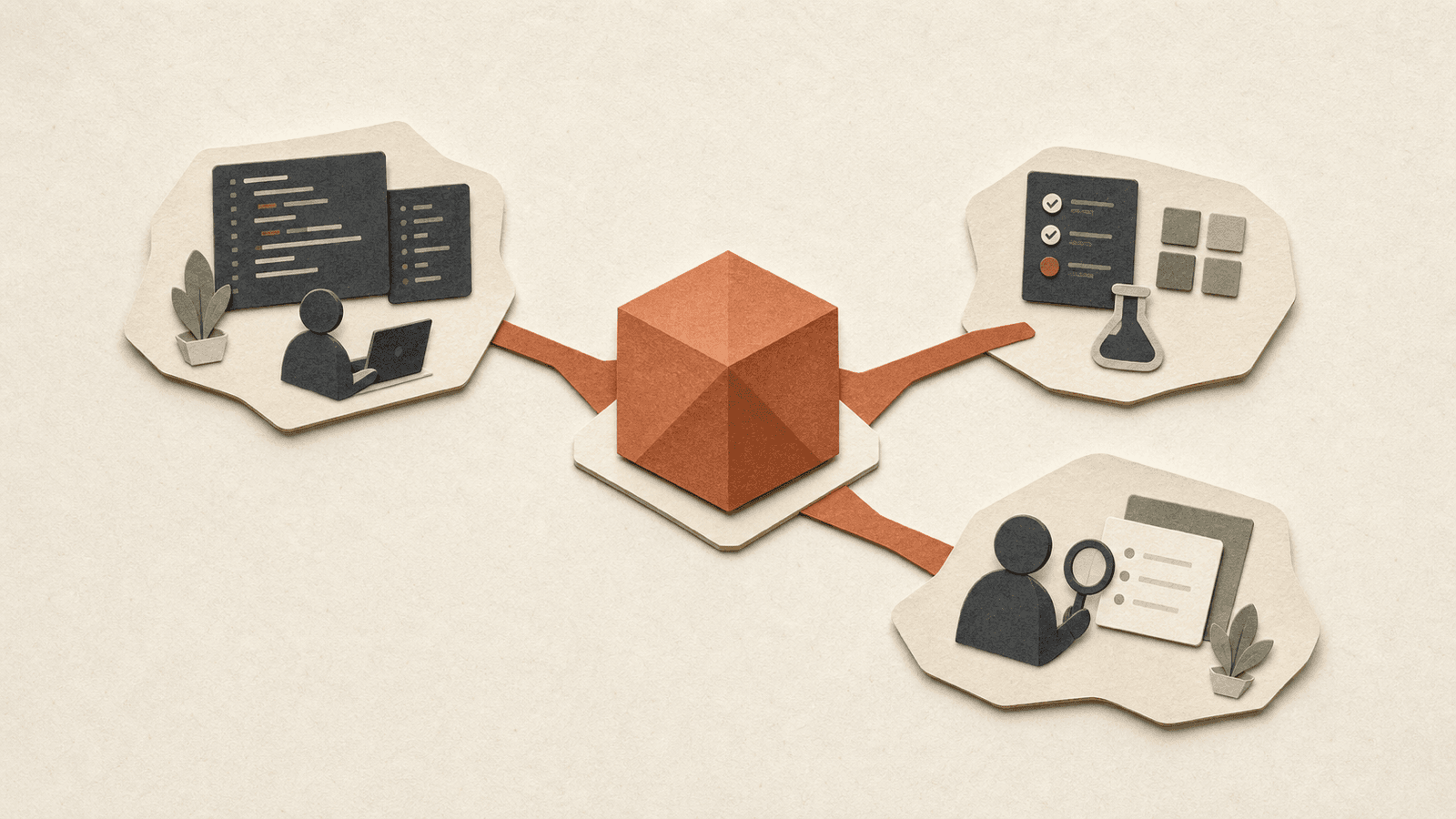
The framing is a false binary. "Multi-agent" bundles two kinds of specialization that the corpus pushes in opposite directions:
- Specialization that encodes hand-engineered task structure (bespoke trained sub-models, rigid orchestration state machines) — the single general agent catches up and overtakes it as models improve. This is The Bitter Lesson.
- Specialization that provides context isolation or evaluative independence (a fresh-context reviewer, an isolated explorer, a grader that isn't the maker) — this does not dissolve with better models, because it addresses structural constraints (quadratic attention, Goodhart's law), not model weakness.
So: a single general agent beats a bespoke, hand-tuned multi-agent system, but a single monolithic-context agent loses to a role-separated one. The winning architecture is one strong model deployed across many fresh contexts (explore → solve → review → merge) with an independent grader — not a bespoke pipeline of per-role trained components.
The case for "single agent overtakes" — the bitter lesson#
The Bitter Lesson: scaled general methods beat hand-engineered structure over time; the structure becomes a ceiling, not a foundation. The corpus's cleanest empirical confirmation is in formal math (Agentic Loops Overtake Bespoke Systems):
- DeepMind chose an elaborate full-featured agent (evolutionary search + the bespoke, RL-trained AlphaProof prover) for large-scale exploration because "simpler agentic loops did not show strong performance" at planning time.
- Post-hoc, the basic agent — independent prover subagents each running a plain generate-edit-compile "Ralph loop" — solved all 9 Erdős problems the full-featured system solved, only at higher cost on the hardest two (#125, #138: 2×–5× cost).
- Verdict: the specialized apparatus's advantage "collapsed to a cost difference, not a capability difference" on most problems, and the authors dated even that residual: "as LLM capabilities grow, this advantage may diminish."
The same dynamic at the orchestration layer: Symphony began treating agents as rigid state-machine nodes (Codex only implements the ticket), found this "too limiting once models grew capable enough," and moved to "objectives + tools, not state transitions" (Agent Harness Engineering). Harness Shrinkage as Models Improve generalizes it: scaffolding that compensates for model weakness becomes drag as the model strengthens — re-evaluate bespoke structure every model release.
But two conditions gate this result — it is not "single agents always win":
- It needs a strong-enough model + a cheap, reliable verifier. Standalone AlphaProof tree-search and smaller-model basic agents solved nothing; the Lean compiler grounding each step is what makes the simple loop viable (The Verifiability Thesis). The transferable rule: when a domain has a cheap reliable verifier, prefer the simplest loop that exploits it.
- It is unresolved in noisy-verifier domains (tests, LLM-judge councils) — an open question the source itself flags.
The case for role separation — what does NOT dissolve#
The multi-agent patterns that survive model improvement are the ones whose specialization is context/role, not task-priors. Three, each with its own evidence:
1. Context isolation is model-independent#
Repository Exploration Subagent (FastContext) supplies the decisive test. Its "same-model exploration" baseline — the frontier model itself does the delegated search through a subagent interface, with no specialized training — already improves resolution and cuts main-agent tokens up to 60% versus monolithic solving. A trained 4B explorer is then a Pareto improvement on top, but:
"The architectural separation is the durable win; the trained model is the optimization."
Exploration is ~56% of a solver's tool-use turns and ~46% of its tokens; moving it out of the solver's window is the gain, independent of any bespoke model. Deep Modules for Agents gives the mechanism: the smart-zone constraint (Context Window Smart Zone) is structural (quadratic attention), so a reviewer in a fresh context reasons in the smart zone where a same-context reviewer reads the diff in the dumb zone — regardless of model size. Its Sandcastle pattern (Planner → N Implementers in worktrees → fresh-context Reviewer → Merger) exists precisely to give each agent its own smart zone.
2. The QA/reviewer is load-bearing because it's separate#
Optimizer–Evaluator Decoupling: "the thing that proposes a change never grades that change." An agent iterating against a metric it also computes converges on gaming its own score, not the goal — Goodhart inside the development loop. This is a structural fix (remove the optimizer's access to the grade), not scaffolding that shrinks. The wiki records independent arrivals at the same invariant — Google's flywheel, Osmani's maker/checker, loop-engineering's separate stop-checker, DRACO's disjoint judges — which is evidence it's a real invariant, not one vendor's taste. So the "testing/QA" specialization in the question is exactly the part you should keep separate.
(Caveats from the same page: decoupling buys independence, not validity — an independent judge can be reliably wrong, e.g. the consistency–bias paradox — and metric design stays coupled if the optimizer authors its own rubric.)
3. The "cleanup" role is real, recurring work#
Agent Harness Engineering: OpenAI initially spent 20% of engineering time on manual "AI slop" cleanup (agents replicate existing patterns, including bad ones). The fix was a specialized recurring role — background agents that scan for deviations, grade quality, and open targeted refactoring/doc-gardening PRs — "garbage collection" paying down debt continuously. A dedicated cleanup agent is not redundant with the solver.
The reconciliation, in one table#
| Kind of "specialized agent" | What it encodes | Bitter-lesson verdict | Keep it? |
|---|---|---|---|
| Bespoke trained sub-model (e.g. AlphaProof prover) | Task priors / domain structure | Advantage → cost-only → drag as models improve | Only at the receding hard frontier; re-check each release |
| Rigid orchestration state machine | Hand-coded control flow | Overtaken by "objectives + tools" | No — give objectives, not transitions |
| Isolated explorer / search subagent | Context isolation | Durable; model-independent gain | Yes |
| Fresh-context reviewer | Context isolation (smart zone) | Durable; structural (quadratic attention) | Yes |
| Independent grader / QA | Evaluative independence | Durable; structural (Goodhart) | Yes |
| Background cleanup / doc-gardener | Continuous entropy management | Durable; recurring real work | Yes |
Three caveats that decide it in practice#
- Verifier availability sets the ceiling. Perfect verifier (Lean, a passing test suite) → high autonomy, simplest loop wins. Noisy/absent verifier → keep the independent reviewer and human gate (Agentic Loops Overtake Bespoke Systems, Verification as the New Bottleneck).
- Multi-agent moves the bottleneck to your review bandwidth. Parallel fan-out is gated by human capacity to review, not model capacity to produce — 28.6% of OpenAI workers peaked at 5+ concurrent agents, and the binding constraint is oversight, not generation (Parallel Agent Orchestration).
- Use role-based model selection, not strongest-everywhere. Cheap/obedient model in explorer/planner seats, strong model in synthesis/review. The combo is the unit of analysis: Ministral 3 8B + Opus scored 74.27% on HotpotQA vs Opus + Opus's 31.71% (Opus-as-planner bypasses the solver's tools) (Client-Side Agent Optimization, Opus 4.6 → 4.7 Changes and Multi-Agent Coding Considerations).
A tension worth flagging#
Vibe Coding vs. Agentic Engineering (Ambrosino) places autonomous single-agent development past orchestrated loops on the frontier ("loops are so last week"), pushing toward the monolithic agent; Deep Modules for Agents and Optimizer–Evaluator Decoupling push toward role separation. These reconcile on the task-priors-vs-context-isolation line drawn above: what Ambrosino predicts dissolving is the hand-coded orchestration, not the context/evaluative separation — the loop's control logic migrates into the model; the fresh-context grader does not.
Sources#
- Agent Harness Engineering — two-agent (Initializer/Coding) architecture; 20% AI-slop cleanup → background refactor agents; Symphony's "objectives, not transitions"; the open question this answers
- The Bitter Lesson — scaled general methods beat hand-engineered structure; the task-priors-vs-deployment/context exemption
- Agentic Loops Overtake Bespoke Systems — basic Ralph loop matched bespoke AlphaProof+evolutionary system on 9/9 Erdős problems; advantage collapsed to a cost line
- Deep Modules for Agents — Sandcastle Planner/Implementers/Reviewer/Merger; reviewer-in-fresh-context; smart-zone constraint is structural
- Repository Exploration Subagent — "same-model exploration" (untrained) already wins: architectural separation is the durable gain, up to 60% main-agent token cut
- Optimizer–Evaluator Decoupling — "the optimizer never grades its own work"; the QA/reviewer separation as a structural (Goodhart) invariant
- Opus 4.6 → 4.7 Changes and Multi-Agent Coding Considerations — role-based model selection, Writer/Reviewer with fresh context, per-agent context budget
- Parallel Agent Orchestration — review bandwidth is the binding constraint on fan-out; concurrency adoption numbers
- Client-Side Agent Optimization — combo selection; Ministral+Opus 74% vs Opus+Opus 31%
- Harness Shrinkage as Models Improve — scaffolding that compensates for model weakness becomes drag; re-evaluate each release
- Verification as the New Bottleneck — why the independent-reviewer step is the durable one
Cited by 6
- Agent Harness Engineering
Patterns for scaffolding long-running LLM agents: environment design, progressive context disclosure, mechanical archit…
- Agentic Loops Overtake Bespoke Systems
DeepMind's *basic* Ralph-loop agent matched its bespoke evolutionary+AlphaProof system as the LLM improved; the bitter…
- Deep Modules for Agents
Ousterhout deep-vs-shallow modules applied to agent-friendly codebases; push-vs-pull instruction delivery; reviewer in…
- Open Questions Backlog
_164 pages with open questions, as of 2026-07-15._
- Optimizer–Evaluator Decoupling
The architectural rule in eval-fix loops that whatever proposes a fix (coding agent, automated optimizer, human) never…
- Repository Exploration Subagent
FastContext's thesis that repository exploration (read/search/localization) should be decoupled from solving into a ded…
Related articles
- Open Questions Backlog
_164 pages with open questions, as of 2026-07-15._
- Agent Harness Engineering
Patterns for scaffolding long-running LLM agents: environment design, progressive context disclosure, mechanical archit…
- AI Engineering & Agent Tooling
Map of Content for the ai-engineering domain — 54 concepts. Curated entry point; see Home for all domains.
- AI-Driven Formal Proof Search
LLM generates Lean, compiler verifies every step → eliminates hallucination; DeepMind resolves 9/353 Erdős + 44/492 OEI…
- Harness Shrinkage as Models Improve
Prompt scaffolding shrinks each model release; Cat Wu's pruning discipline; Boris Cherny "100 lines of code a year from…