Sources#
Summary#
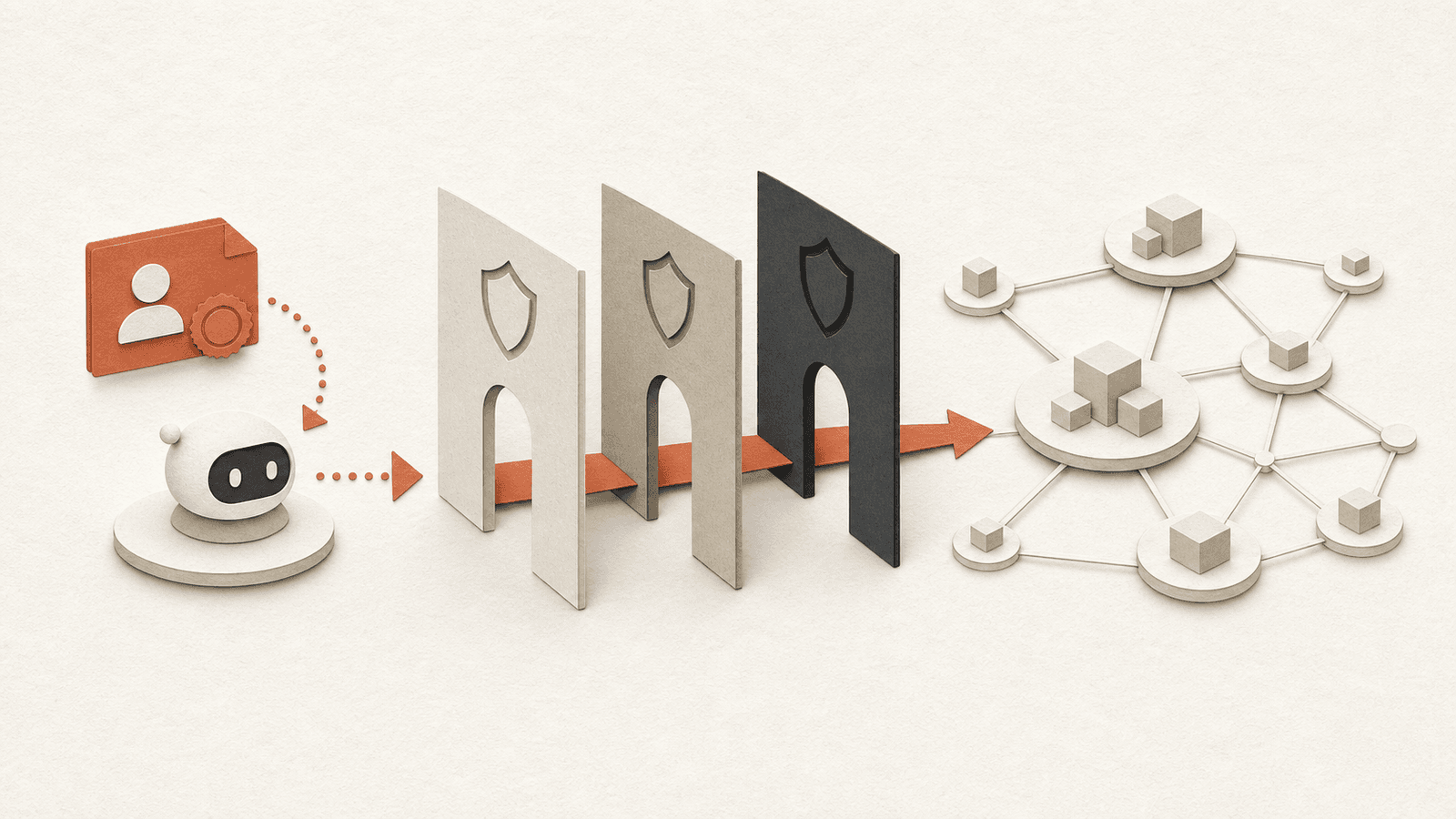
AIMS is the conceptual model at the center of IETF Internet-Draft draft-klrc-aiagent-auth-03 (Kasselman/Lombardo/Rosomakho/Campbell/Steele/Parecki — Defakto/AWS/Zscaler/Ping/OpenAI/Okta; July 2026). Its thesis: an AI agent is a workload, and the identity, authentication, and authorization problems it raises are not new — they should be solved by composing existing, widely-deployed standards (WIMSE/SPIFFE workload identity, the OAuth 2.0 family, OpenID Shared Signals) rather than inventing agent-specific protocols. AIMS is "the set of functions required to establish, maintain, and evaluate the identity and permissions of an agent workload" — a conceptual model, not a product, protocol, or single architecture; it may live in one component or be spread across identity providers, provisioning services, authorization servers, policy engines, and runtime enforcement points.
Evidence caveat (attach everywhere): this is a standards-track proposal — an individual submission, Informational, with no IETF Working Group consensus yet (it profiles specs from the IETF, CNCF, and OpenID Foundation but is not itself ratified). Treat every MUST/SHOULD as the authors' recommendation, not an adopted standard. Its evidence: tier is practitioner-opinion.
Why it matters to this vault: the agent-security cluster was sourced almost entirely to one vendor ebook (Zero Trust for AI Agents). AIMS is the first standards-track, multi-vendor primary source on agent identity, and it directly targets two long-standing open questions — sub-agent credentialing (Agent Identity and Authentication) and the agent-to-agent trust protocol layer (Agent-Native Infrastructure).
Agents are workloads (the framing move)#
An Agent is a workload that iteratively interacts with an LLM and a set of Tools/Services/Resources until a terminating condition is reached (Figure 1 of the draft). Because it is a workload, it needs an identifier and credentials so it can be authenticated by the parties it touches — and, if it acts for a user or system, that principal must delegate authority to it, with the delegated context preserved into authorization decisions and audit trails. This reframing is what lets the whole problem be solved with workload-identity and delegated-authorization standards instead of new machinery.
Notably, "a Tool endpoint may itself be implemented by another AI agent" — so agent-to-agent is just the workload-to-workload case, and the same primitives cover it.
The layered stack (Figure 2)#
AIMS is a logical stack where higher layers depend on guarantees from lower ones, with two cross-cutting columns:
Policy | [ Monitoring, Observability & Remediation ] | Compliance
 | [ Authorization ] |
 | [ Authentication ] |
 | [ Provisioning ] |
 | [ Credentials ] |
 | [ Identifier ] |
- Identifier → Credentials → Provisioning → Authentication → Authorization → Monitoring is the dependency chain.
- Policy (§12) and Compliance (§13) span all layers but are declared out of scope — deployment-, regulatory-, and jurisdiction-specific, and explicitly not a standardization target. Policy MAY be any versioned, reviewable "policy-as-code" format.
Identifier: WIMSE, with SPIFFE as the deployed instance#
Each agent MUST have exactly one WIMSE identifier ([WIMSE-ID]) — a URI uniquely identifying a workload within a trust domain, stable for the identity's lifetime (authorization, delegation, and audit all key off it). It MAY be a SPIFFE ID (spiffe://<trust-domain>/<path>), which the draft calls the "widely deployed and operationally mature instance of the WIMSE identifier model." This is the concrete answer to "what is a per-agent identity" — a workload-identity URI, not an ad-hoc label.
Credentials + provisioning + posture assessment#
- Credentials cryptographically bind the identifier to the agent. WIMSE defines the WIT (Workload Identity Token) and WIC (X.509 Workload Identity Certificate); SPIFFE defines X.509-SVID, WIT-SVID, and JWT-SVID. They SHOULD be short-lived with an explicit expiry. Static API keys are named an antipattern — bearer artifacts, not cryptographically bound, long-lived, hard to rotate.
- Hardware-backed key storage (TPM, enclave, platform security module) is optional — "not required for interoperability." (This is the sharpest divergence from the ebook — see comparison below.)
- Provisioning is runtime issuance/renewal/rotation in two phases (initial provisioning; automatic rotation before expiry). Short-lived credentials are offered as an alternative to explicit revocation: you don't revoke, you just don't renew.
- Posture assessment happens at each provisioning/rotation event — the draft (v-02 onward) folded the old "attestation" section into provisioning and renamed it "posture management." It evaluates deployment-specific signals (hardware/TEE evidence, software-integrity measurements, supply-chain provenance, orchestration metadata, workload placement, operator assertions) to decide whether a credential issues, which identifier binds, what type, what attributes, and how long it lives. A single signal may suffice; higher-risk deployments require several. No particular attestation mechanism is required.
- Credential exchange for legacy/proprietary environments incompatible with the primary credential: OAuth 2.0 Token Exchange, Transaction Tokens, or Workload Identity Federation mint a targeted secondary credential from the primary one.
The rule: LLMs never hold credentials#
"The Large Language Model MUST NOT have access to an agent's credentials or to credentials that may be needed to access tools and services." Rationale, stated verbatim: to prevent the LLM from using, exposing, or being manipulated via prompt injection into disclosing the credentials. This is the identity-layer sibling of the out-of-band reference-monitor doctrine — the secret sits outside the manipulable model, and the agent (the workload), not the model, wields it. (Added in -03 as [issue #127].)
Authentication: transport vs application layer#
Per the WIMSE architecture, auth can happen at either layer, and many deployments use both:
- Transport-layer — mTLS, both endpoints presenting X.509 credentials; paired with short-lived SPIFFE/WIMSE identity it gives strong channel binding. Well-suited to service meshes (Istio, LinkerD). Limitation: intermediaries (proxies, API gateways, service meshes, load balancers, protocol translators) terminate and re-establish TLS, breaking end-to-end transport identity — and serverless/multi-tenant-edge/cross-domain topologies obscure transport identity.
- Application-layer — survives intermediaries by binding identity above the transport. Two WIMSE mechanisms:
- WIMSE Proof Tokens (WPTs) — a signed JWT proving possession of the WIT's private key, bound to a specific message context (e.g. an HTTP request), with claims
aud/exp/jti/wth(hash of the WIT). Proof-of-possession, not bearer. Protocol-agnostic core (can bind Kafka, gRPC, non-HTTP). - HTTP Message Signatures ([WIMSE-HTTPSIG] over RFC 9421) — combine the WIT with a signature over request components (method, request-target, content digest, the WIT itself), giving proof-of-possession + message integrity end-to-end.
- Limitation: no inherent channel binding, so implementations must defend against relay/replay via short lifetimes, audience restriction, nonces, and request binding.
Authorization: OAuth 2.0 as the delegation spine#
- Agent Mission (§10.1) — an agent receives a Mission (a natural-language task) from a user, system, or another agent; translating the mission into concrete resource/authorization requirements is a planning step, out of scope (the draft cites Karl McGuinness's "Mission Shaping Problem"). This is where the wiki's agent-native "figure out the details" handshake meets a concrete auth model.
- OAuth as delegation — the agent acts as an OAuth client; access tokens carry the agent identity as
client_idand the delegated principal assub. Flows: Authorization Code Grant when a user delegates (with phishing-resistant user auth like passkeys, and the agent authenticating to the AS with its Section-7 credentials, never static client secrets); Client Credentials / JWT Authorization Grant when the agent acts on its own behalf; and agents themselves can be OAuth protected resources invoked by a system or another agent. - Transaction Tokens (§10.5) — the blast-radius control for internal call chains. A broad access token passed between microservices is a theft/replay/lateral-move risk (an attacker who finds it in a log or crash dump can invoke a different transaction). Instead, exchange it for a transaction token: a downscoped token bound to one specific transaction (enriched with caller context, transaction context, a unique ID) that cannot be reused for another transaction or with modified details. Short-lived. A transaction token MAY be exchanged (OAuth Token Exchange) for an access token to call the next service.
- Cross-domain chaining (§10.6) — when resources sit behind different authorization servers, the agent uses OAuth Identity and Authorization Chaining Across Domains (or the Identity Assertion JWT Grant / Transaction Token Grant profiles): exchange the current token for a JWT authorization grant, present it to obtain an access token for the target domain. This is the delegation-chain mechanism for ephemeral spawned agents.
- Human in the loop (§10.7) — for high-risk actions the AS SHOULD decline or step up via CIBA (out-of-band approval on the user's device). Crucially, local UI confirmation is not authorization — the draft aligns with MCP's user-solicitation pattern but insists the agent MUST NOT treat a local approval as sufficient; it must be bound to a verifiable AS-issued grant. (Noted gap: CIBA only models client-initiated flows and doesn't map cleanly to mid-execution confirmation.)
- Tool-to-service (§10.8) — tools use Token Exchange / cross-domain chaining to reach downstream resources. Anti-pattern: a tool forwarding the access token it received from the agent (invites theft + lateral attacks) — the same containment logic as transaction tokens.
- Discovery (§10.10) — in dynamic/ephemeral deployments, OAuth Authorization Server Metadata, Protected Resource Metadata, and Client ID Metadata Documents let agents bind to the right issuer/audience/flow at runtime without static config.
Observability and remediation as a security control (§11)#
Monitoring is "a security control, not solely an operational feature." Participants MAY subscribe to the OpenID Shared Signals Framework (SSF) with CAEP or RISC to receive signals (session revoked, risk elevated, token replay suspected, subject disabled) and MUST remediate promptly — discard cached tokens, re-acquire with tighter constraints, reduce privileges, re-run policy — and MUST NOT keep using authorization invalidated by a revocation. Deployments MUST keep tamper-evident audit logs (authenticated agent ID, delegated subject, resource, action + decision, timestamp/correlation ID, posture/risk state, remediation events) and SHOULD correlate across agents/tools/LLMs to detect replay, confused-deputy, privilege escalation, and anomalous sequences. Stable verifiable identifiers everywhere are what make "which entity did what, using which authorization context, and why access changed" reconstructable end-to-end.
Comparison: AIMS vs the Anthropic Zero-Trust ebook#
Both target per-agent identity for agentic Zero Trust and converge on the core: static API keys are unacceptable, credentials must be short-lived and cryptographically bound, per-agent identity is the keystone, least privilege / minimal scopes, and observability-as-security-control with tamper-evident audit. But they diverge on primitives and authority:
| Dimension | Zero Trust for AI Agents (Anthropic ebook, vendor) | AIMS (IETF draft, multi-vendor standards) |
|---|---|---|
| Identity primitive | Cryptographic IDs → X.509 certs → hardware-backed HSM/TPM identity + remote attestation (tiered target state) | WIMSE/SPIFFE URI as the identifier (X.509-SVID or JWT/WIT-SVID) |
| Hardware attestation | The Advanced-tier target for internet-reachable production | Optional; "not required for interoperability" — one posture signal among many |
| Attestation model | Remote hardware attestation | "Posture assessment" at each issuance/rotation; deployment-specific signals (folds attestation into provisioning) |
| Authentication | Short-lived OAuth tokens → mTLS → hardware-bound credentials | Same, plus application-layer (WPT, HTTP Message Signatures) for when transport identity breaks |
| Delegation / sub-agents | Sub-agents inherit "up to the same permissions as the parent" (left largely open) | OAuth Token Exchange + Transaction Tokens + cross-domain chaining — downscoped, transaction-bound, not raw inheritance |
| LLM & credentials | Not stated as a rule | Explicit MUST NOT — the LLM never holds credentials |
| Authority | Single vendor; Claude Code as reference implementation | Six vendors, standards-track — but an individual submission, no WG consensus |
The productive tension: the ebook drives toward hardware attestation as the aspirational endpoint; AIMS argues you can get the security property from short-lived, posture-assessed, delegated credentials without requiring hardware attestation on every ephemeral workload — and adds the delegation-chain machinery (transaction tokens, identity chaining) the ebook lacks. Neither is a ratified standard: the ebook is vendor practitioner-opinion, AIMS is standards-draft practitioner-opinion.
Connections#
- Agent Identity and Authentication — the primary sibling; AIMS is the second (standards-track, multi-vendor) source on the same keystone control, and supplies the concrete identifier/credential/delegation primitives the ebook left at the tier-label level
- Zero Trust for AI Agents — the vault's other agent-security framework (hub); AIMS composes existing standards where the ebook prescribes a tiered maturity model — convergences and divergences tabled above
- Least Agency — AIMS enforces least agency through OAuth minimal scopes, audience restriction, and transaction-token downscoping (a token bound to one transaction that can't be reused) — the standards-layer instantiation of "restrict what each tool can do"
- Blast Radius (Agentic) — transaction tokens, the no-token-forwarding anti-pattern, and short-lived non-revoked credentials are all blast-radius containment for the internal microservice call chain (limiting token theft, replay, and lateral movement)
- Agent-Native Infrastructure — AIMS is a candidate answer to that page's open protocol-layer question: the trust/identity/accountability primitives for agent-to-agent negotiation, drawn from IETF/CNCF/OpenID standards (though governance is unsettled)
- Out-of-Band Prompt-Injection Defense — same doctrine at the identity layer: keep the secret and the authorization decision outside the manipulable LLM (LLMs-never-hold-credentials; the AS, not local UI, authorizes) — the credential/authorization twin of the deterministic reference monitor
- Agentic Prompt Injection — the LLM-never-holds-credentials rule is explicitly a prompt-injection defense: a hijacked model can't disclose a secret it never had
- MCP and Computer Use — AIMS aligns its human-in-the-loop model with MCP's user-solicitation pattern, and treats MCP tools as the resource surface OAuth authorizes; but insists local approval is not authorization
- Hermes Agent — a shipped contrast: Hermes secures multi-user agent access with an ad-hoc DM-pairing + allowlist (human-auth) plus container-as-boundary, where AIMS proposes standards-based workload identity + delegated authorization; the gap between practice and the proposed standard
- OpenAI — Nick Steele (OpenAI) is a co-author, alongside Defakto, AWS, Zscaler, Ping Identity, and Okta
Open Questions#
- No WG consensus. This is an individual submission profiling other still-in-progress drafts (WIMSE identifier/creds/WPT/HTTP-sig, OAuth transaction-tokens, identity-chaining are all Internet-Drafts too). Which of these primitives actually reach RFC, and does the composition survive WG review? "Who governs the agent-auth protocol layer" (Agent-Native Infrastructure) is proposed (IETF/CNCF/OpenID) but not settled.
- Mission → authorization is out of scope. The hardest part — translating a natural-language mission into concrete scopes/resources safely — is explicitly deferred as a "planning step." A manipulated planning step requests over-broad authorization; AIMS gives it clean primitives but no account of securing the translation itself.
- Mid-execution human-in-the-loop. The draft admits CIBA only models client-initiated approval and "doesn't map well" to confirmation needed mid-execution — an acknowledged specification gap.
- Posture assessment is deployment-specific by design. By requiring no particular attestation mechanism, AIMS makes interoperability of trust assurance (not just protocol) unspecified: two conformant AIMS deployments can assess posture with wholly different, non-comparable signals.
- No empirical evaluation. Unlike Out-of-Band Prompt-Injection Defense (which at least ran one adaptive reproduction), AIMS is a design document with no measured attack-resistance — its security rests on the composed specs' own (mostly non-agentic) threat models.
Sources#
- AI Agent Authentication and Authorization — IETF Internet-Draft
draft-klrc-aiagent-auth-03, AI Agent Authentication and Authorization (Informational, individual submission), 6 July 2026,practitioner-opinion. §4 (agents are workloads, Figure 1), §5 (AIMS stack, Figure 2), §6 (WIMSE/SPIFFE identifier), §7 (credentials; static-key antipattern; hardware-backing optional), §8 (provisioning + posture assessment; LLMs-never-hold-credentials rule), §9 (transport mTLS vs application-layer WPT / HTTP Message Signatures), §10 (OAuth delegation, mission, transaction tokens, cross-domain chaining, CIBA human-in-the-loop, tool-to-service, discovery), §11 (SSF/CAEP/RISC monitoring + tamper-evident audit)
Cited by 10
- Agent Identity and Authentication
The foundation control for agentic Zero Trust: cryptographically-rooted per-agent identity (→X.509→hardware attestation…
- Agent-Native Infrastructure
The world is still built for humans and must be rewritten for agents; "what do I copy-paste to my agent?"; sensors/actu…
- Agentic Prompt Injection
Direct and indirect injection of malicious instructions into an agent; LLMs cannot reliably distinguish information fro…
- Blast Radius (Agentic)
The potential damage if an agent is compromised; the unit Zero Trust's 'assume breach' posture is built to contain via…
- Least Agency
OWASP term extending least privilege to agents: constrain not just what an agent can access but what each tool can do,…
- MCP and Computer Use
Anthropic's two complementary connector mechanisms: MCP for structured programmatic access (Salesforce/Drive/Gmail/Slac…
- AI Engineering & Agent Tooling
Map of Content for the ai-engineering domain — 54 concepts. Curated entry point; see Home for all domains.
- Open Questions Backlog
_164 pages with open questions, as of 2026-07-15._
- Out-of-Band Prompt-Injection Defense
The second-generation defense strategy that enforces agent security OUTSIDE the model — a deterministic reference monit…
- Zero Trust for AI Agents
Anthropic's security framework for deploying autonomous agents: trust nothing / verify everything / assume breach, appl…
Related articles
- Least Agency
OWASP term extending least privilege to agents: constrain not just what an agent can access but what each tool can do,…
- Zero Trust for AI Agents
Anthropic's security framework for deploying autonomous agents: trust nothing / verify everything / assume breach, appl…
- MCP and Computer Use
Anthropic's two complementary connector mechanisms: MCP for structured programmatic access (Salesforce/Drive/Gmail/Slac…
- Impossible, Not Tedious (Design Test)
Zero Trust design test for agentic security: does a control make the attack impossible, or just tedious? Friction-only…
- Agent Identity and Authentication
The foundation control for agentic Zero Trust: cryptographically-rooted per-agent identity (→X.509→hardware attestation…