Sources#
Summary#
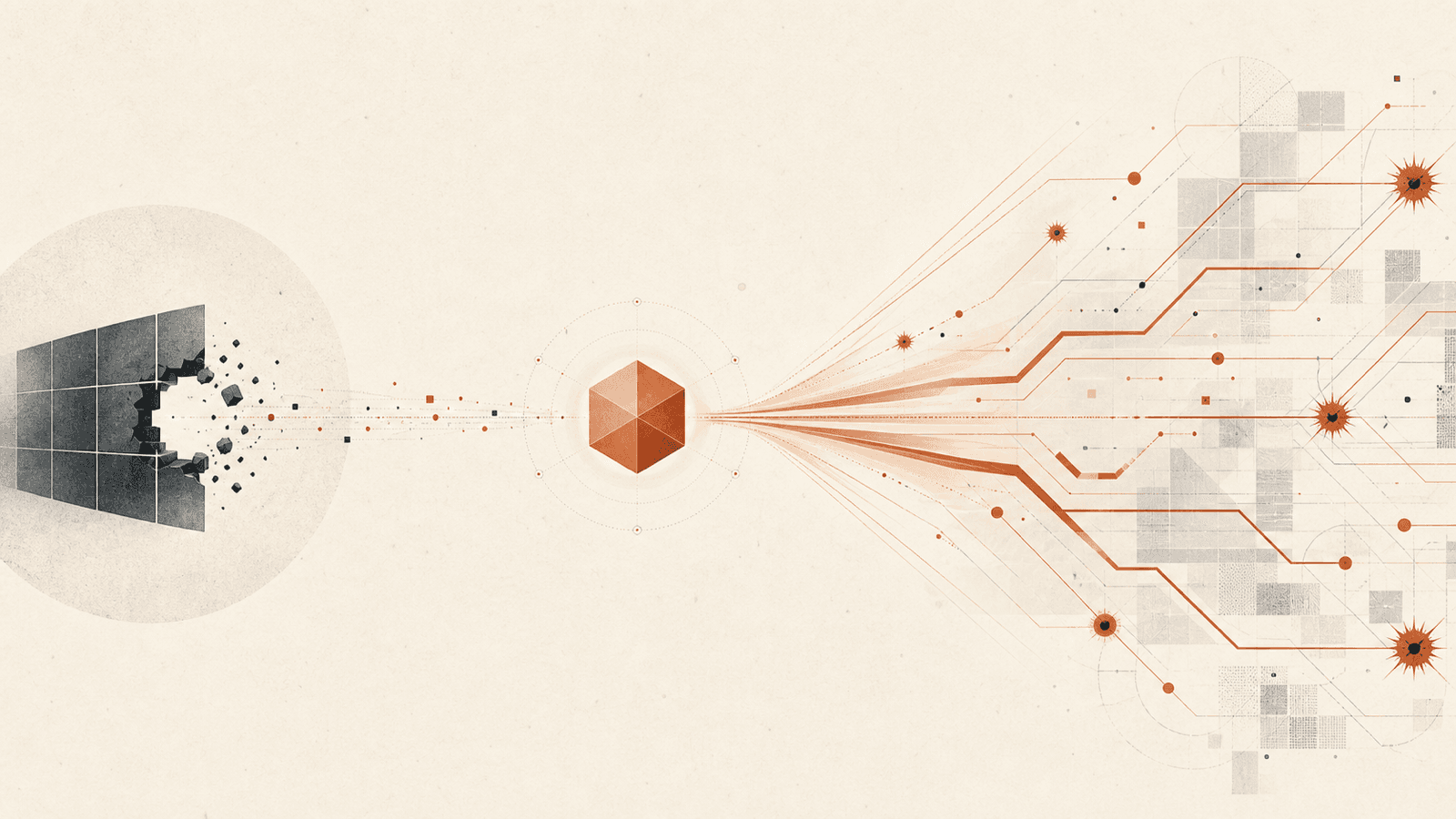
The "why now" behind Zero Trust for AI Agents: frontier AI models are compressing the timeline between vulnerability and exploit from months to hours, at a marginal cost measured in dollars. Perimeter-based defenses can't keep up, and the threats themselves are accelerating. This is not speculative — models already find serious vulnerabilities that traditional tooling and human reviewers missed for years (the empirical case is documented in LLM-Driven Vulnerability Research). AI-accelerated offense is the force that raises the Zero Trust "Foundation floor" and breaks friction-based controls (Impossible, Not Tedious (Design Test)).
The double speed-up#
The acceleration cuts both ways, and matters twice for anyone deploying agents:
- The infrastructure agents run on is exposed to AI-accelerated offense like the rest of the estate.
- The agents themselves add autonomy (goal interpretation, tool selection, multi-step execution) that traditional access controls weren't built to constrain.
Defenders who adopt the tools find and fix bugs faster; attackers who adopt them — or who simply wait for defenders' patches and reverse-engineer them into exploits — move faster too. The asymmetry the framework highlights: even a purely reactive attacker benefits, because patches are a public signal that can be weaponized.
Consequences for defenders#
- The N-day window collapses — autonomous CVE-to-exploit pipelines mean the gap between disclosure and mass exploitation shrinks; patch cycles must tighten. A two-week change-approval cycle for production patches is "itself a security risk."
- Auto-update reflex flips — the framework recommends enabling automatic updates on components where an update-caused outage is acceptable, because manual-approval delay is now the bigger risk (paired with signature verification).
- Volume scales an order of magnitude — plan and rehearse for "five simultaneous incidents, not one" (see Autonomous Defense).
- Dwell time and coverage are the high-leverage metrics — AI automation moves these most, and they matter most when exploit windows shorten.
The counter-intuitive differentiator#
The framework's central strategic claim: "The organizations best positioned for this shift will not necessarily be the ones with the most advanced AI. They will be the ones whose fundamentals are strong enough that AI-assisted scanning finds fewer bugs in the first place, and whose agent deployments were architected for breach from day one." Capability does not substitute for hygiene — it raises the penalty for lacking it.
Connections#
- Zero Trust for AI Agents — the framework AI-accelerated offense motivates; it raised the Foundation floor in response (hub)
- LLM-Driven Vulnerability Research — the empirical evidence: Mythos-class models autonomously discovering zero-days and chaining exploits
- Impossible, Not Tedious (Design Test) — near-zero per-attempt cost is precisely what breaks friction controls
- Agent Supply Chain Risk — models recognize known-vuln signatures in unpatched upstream components, weaponizing the supply chain
- Autonomous Defense — the necessary response: run security ops at the speed of the threat
- Claude Opus 4.7 — first post-Glasswing GA model; the safeguards built against this acceleration
Open Questions#
- Anthropic argues LLMs benefit defenders more long-term (like fuzzers) but attackers more short-term during the transition. How long is the transition, and what determines who wins it?
- "Fundamentals strong enough that scanning finds fewer bugs" assumes defenders run the scanners first. What happens to organizations that can't afford continuous model-driven scanning?
Sources#
- Zero Trust for AI Agents — "Building for the next threat landscape" (opening) and the closing chapter; reprised across Parts II and V
Cited by 10
- Agent Supply Chain Risk
Runtime-composed agent ecosystems expand the supply-chain attack surface: model poisoning (250 docs backdoor a 13B mode…
- Autonomous Defense
Running security operations at the speed of AI-accelerated threats: put a model at the front of the alert queue, automa…
- Blast Radius (Agentic)
The potential damage if an agent is compromised; the unit Zero Trust's 'assume breach' posture is built to contain via…
- Claude Opus 4.7
GA frontier model from Anthropic; direct upgrade to 4.6 at same price; literal instruction following, 1.0–1.35× tokeniz…
- Impossible, Not Tedious (Design Test)
Zero Trust design test for agentic security: does a control make the attack impossible, or just tedious? Friction-only…
- LLM-Driven Vulnerability Research
Claude Mythos Preview's emergent cybersecurity capabilities: autonomous zero-day discovery, full exploit chains, and An…
- AI Engineering & Agent Tooling
Map of Content for the ai-engineering domain — 45 concepts. Curated entry point; see Home for all domains.
- Open Questions Backlog
_124 pages with open questions, as of 2026-06-19._
- Responsible Scaling Policy Evaluations
Anthropic's RSP gates deployment on pre-release capability evaluations in CBRN, automated AI R&D, and high-stakes misal…
- Zero Trust for AI Agents
Anthropic's security framework for deploying autonomous agents: trust nothing / verify everything / assume breach, appl…
Related articles
- Least Agency
OWASP term extending least privilege to agents: constrain not just what an agent can access but what each tool can do,…
- LLM-Driven Vulnerability Research
Claude Mythos Preview's emergent cybersecurity capabilities: autonomous zero-day discovery, full exploit chains, and An…
- Zero Trust for AI Agents
Anthropic's security framework for deploying autonomous agents: trust nothing / verify everything / assume breach, appl…
- Agent Identity and Authentication
The foundation control for agentic Zero Trust: cryptographically-rooted per-agent identity (→X.509→hardware attestation…
- Blast Radius (Agentic)
The potential damage if an agent is compromised; the unit Zero Trust's 'assume breach' posture is built to contain via…